
Anthropic Claude API Pricing 2026: Artificial Intelligence APIs have become the backbone of modern applications, and Anthropic’s Claude API is one of the most powerful options available in 2026. Whether you’re building AI chatbots, coding assistants, content generators, research tools, or business automation systems, understanding Claude API pricing is essential for controlling costs and maximizing performance.
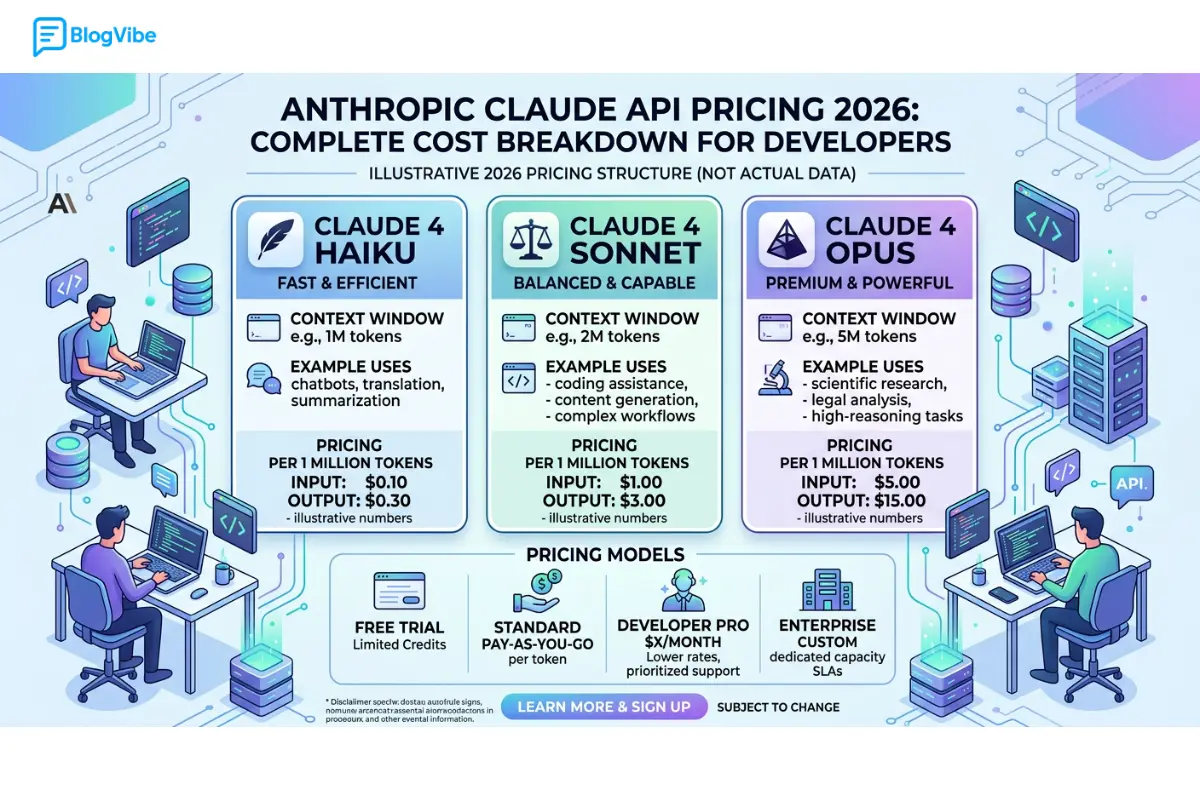
In this guide, we’ll break down Anthropic Claude API pricing, compare Claude models, explain token costs, and show practical examples to help developers and businesses choose the right model.
What Is the Claude API?
The Claude API is a cloud-based AI service provided by Anthropic that allows developers to integrate Claude’s language models into applications, websites, software products, and automation workflows.
Popular use cases include:
- AI chatbots
- Customer support automation
- Code generation
- Content creation
- Document analysis
- Research assistants
- AI agents
- Business workflow automation
How Claude API Pricing Works
Claude API uses a token-based pricing model.
You pay for:
- Input Tokens – Text sent to Claude.
- Output Tokens – Text generated by Claude.
A token is a small piece of text. Roughly speaking, 1 million tokens can represent hundreds of thousands of words depending on language and formatting.
Claude API Models Available in 2026
Anthropic offers multiple model tiers designed for different workloads.
Claude Haiku
Haiku is the fastest and most affordable model.
Best for:
- Chatbots
- Classification tasks
- Simple automation
- High-volume applications
Advantages:
- Low cost
- Fast response times
- Scalable for large user bases
Claude Sonnet
Sonnet is Anthropic’s balanced model.
Best for:
- Content creation
- Business applications
- Coding assistance
- AI agents
- Research tasks
Advantages:
- Strong reasoning
- Excellent coding performance
- Cost-effective balance between speed and quality
Claude Opus
Opus is Anthropic’s flagship model.
Best for:
- Complex reasoning
- Advanced coding
- Research analysis
- Enterprise applications
- Long-context processing
Advantages:
- Highest intelligence level
- Better problem-solving
- Improved accuracy on difficult tasks
Claude API Pricing Overview
Current public pricing information shows approximate rates per one million tokens:
| Model | Input Cost | Output Cost |
| Claude Haiku | ~$1 | ~$5 |
| Claude Sonnet | ~$3 | ~$15 |
| Claude Opus | ~$5 | ~$25 |
Actual pricing may vary as Anthropic updates models and billing policies. Always verify current rates before launching production workloads.
Understanding Prompt Caching
Prompt caching can significantly reduce costs.
With caching:
- Frequently reused prompts are stored
- Repeated requests become cheaper
- Latency is reduced
- Large-scale applications save money
This feature is particularly useful for:
- Customer support bots
- AI agents
- SaaS applications
- Internal business tools
Public pricing documentation indicates cache reads are substantially cheaper than normal input tokens.
Batch API Pricing
Anthropic also offers Batch API processing for non-urgent workloads.
Benefits include:
- Lower costs
- Large-volume processing
- Better efficiency for background jobs
Ideal use cases:
- Data analysis
- Content generation
- Bulk document processing
- AI training pipelines
Batch processing can reduce costs significantly compared to standard real-time requests.
Cost Example: AI Chatbot
Imagine your chatbot processes:
- 500,000 input tokens monthly
- 500,000 output tokens monthly
With Sonnet-level pricing:
Monthly costs remain relatively affordable for startups while providing strong AI capabilities. Exact expenses depend on conversation length and user activity.
Cost Example: Content Generation Platform
Suppose you generate:
- Blog articles
- Product descriptions
- Marketing copy
A content platform producing millions of tokens per month can often reduce expenses by:
- Using Sonnet for most tasks
- Reserving Opus for complex reasoning
- Enabling prompt caching
- Using batch processing where possible
Which Claude Model Should You Choose?
Choose Haiku If:
- Cost is your top priority
- You need fast responses
- Tasks are relatively simple
Choose Sonnet If:
- You want the best balance
- You create content
- You build SaaS products
- You need strong coding support
Choose Opus If:
- You need advanced reasoning
- Accuracy is critical
- You work with complex research
- Enterprise performance matters
Tips to Reduce Claude API Costs
1. Use the Smallest Suitable Model
Not every task requires Opus.
Many workloads perform extremely well with Sonnet or Haiku.
2. Reduce Prompt Length
Shorter prompts consume fewer tokens.
3. Limit Output Length
Set reasonable output limits.
4. Enable Prompt Caching
This can dramatically reduce recurring costs.
5. Use Batch Processing
Background jobs often don’t require real-time responses.
Claude API vs Other AI APIs
Compared with other major AI providers, Claude remains highly competitive in:
- Coding performance
- Long-context understanding
- Document analysis
- Enterprise reliability
- AI agent workflows
Many developers prefer Sonnet because it offers near-flagship performance at a significantly lower cost than premium models.
Final Thoughts
Anthropic Claude API pricing in 2026 remains flexible for both startups and enterprises. With multiple model tiers, prompt caching, batch processing, and large context windows, developers can optimize costs while accessing powerful AI capabilities.
For most applications, Claude Sonnet offers the best balance of performance and affordability. Businesses requiring maximum intelligence and reasoning power may find Claude Opus worth the additional expense, while high-volume applications can benefit from Claude Haiku’s lower costs.
As Anthropic continues to improve its models, understanding token usage and cost optimization strategies will help developers build scalable AI-powered products without overspending.
FAQs
How does Claude API pricing work?
Claude API charges based on the number of input and output tokens processed.
Which Claude model is cheapest?
Claude Haiku is generally the most affordable option.
Which Claude model is best for coding?
Claude Sonnet and Claude Opus are both strong choices for software development tasks.
Does Claude support prompt caching?
Yes. Prompt caching is available and can help reduce costs for repeated prompts.
Is Claude API suitable for startups?
Yes. The availability of multiple pricing tiers allows startups to scale gradually as usage grows.