
Every minute matters when treating a stroke. According to medical experts, millions of brain cells can die each minute that blood flow is interrupted. That’s why hospitals increasingly rely on intelligent imaging platforms that analyze brain scans in seconds rather than minutes.
One of the most recognized solutions in this field is Rapid AI.
Whether you’re a healthcare professional, developer, job seeker, student, or simply researching medical AI, understanding how Rapid AI works can help you appreciate why it has become an essential part of modern stroke care.
In this guide, you’ll learn what Rapid AI is, how it works, its key products, API capabilities, career opportunities, software ecosystem, and whether it’s worth considering in 2026.
Table of Contents
- What Is Rapid AI?
- Why Rapid AI Matters
- How Rapid AI Works
- Key Features
- Rapid AI Software Suite
- Rapid AI App Overview
- Rapid AI API for Developers
- Rapid AI Vision Technology
- Rapid AI Company Overview
- Rapid AI Careers
- Rapid AI Salary Expectations
- Rapid AI Glassdoor Reviews
- Rapid AI Photos and Medical Imaging
- Comparison with Traditional Stroke Imaging
- Pros and Cons
- Common Mistakes
- Best Practices
- FAQs
- Conclusion
- Key Takeaways
What Is Rapid AI?
Rapid AI is an advanced medical imaging software platform designed to help hospitals diagnose and treat stroke, aneurysm, pulmonary embolism, and other vascular diseases faster.
Instead of replacing doctors, Rapid AI assists medical teams by automatically analyzing CT and MRI scans within minutes. The software identifies potential abnormalities, estimates damaged brain tissue, and helps physicians decide on the best treatment.
Today, thousands of hospitals worldwide use Rapid AI to improve emergency stroke care.
Why Rapid AI Matters in Modern Healthcare
Time is the biggest factor during emergency stroke treatment.
Without advanced imaging tools, doctors may spend valuable time manually reviewing scans.
Rapid AI helps by:
- Detecting suspected stroke earlier
- Prioritizing emergency cases
- Providing quantitative imaging results
- Reducing treatment delays
- Supporting better clinical decisions
For patients, even saving a few minutes can significantly improve recovery outcomes.
How Does Rapid AI Work?
The platform combines medical imaging with artificial intelligence algorithms.
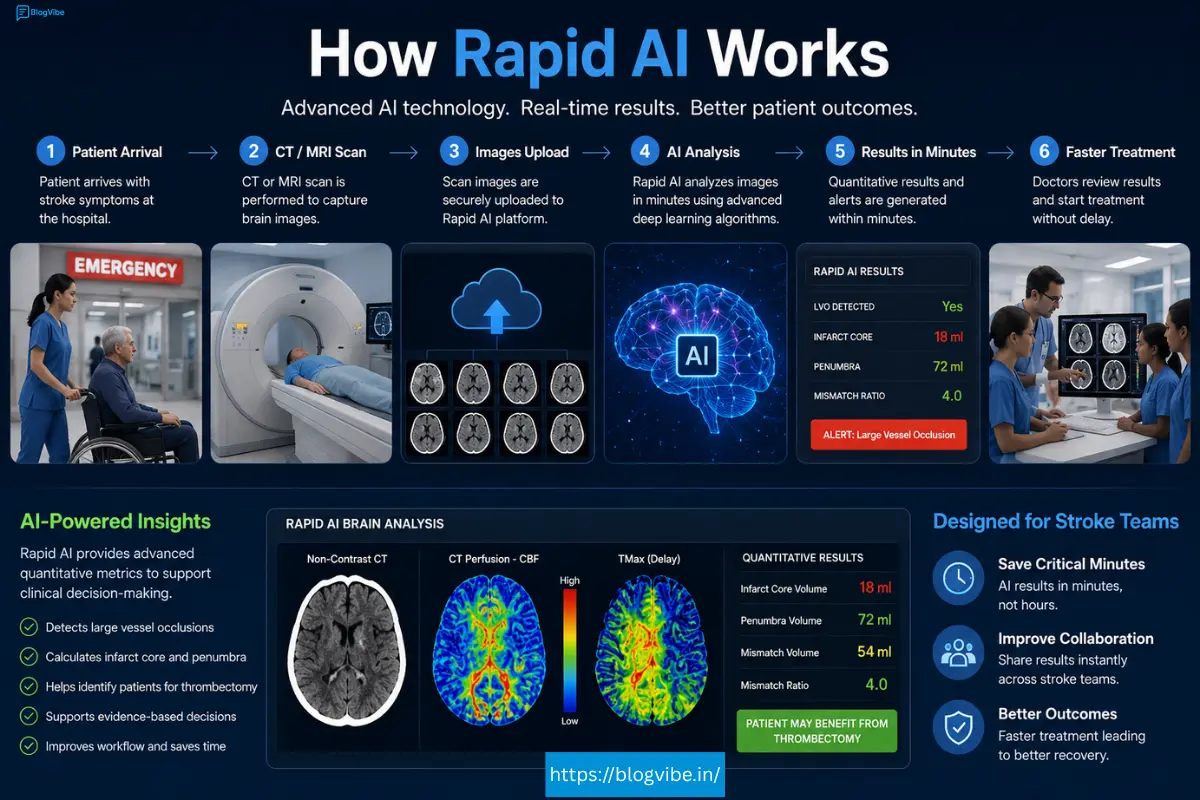
A simplified workflow looks like this:
- The patient arrives with stroke symptoms.
- CT or MRI scan is performed.
- Images are uploaded to Rapid AI software.
- AI analyzes blood vessels and brain tissue.
- Results appear within minutes.
- Doctors review AI findings.
- Treatment decisions begin immediately.
Notice that physicians remain responsible for diagnosis—the AI acts as a decision-support tool rather than replacing medical expertise.
Key Features of Rapid AI
1. Automated Stroke Detection
The software quickly identifies suspected ischemic stroke cases.
2. Brain Perfusion Analysis
It estimates:
- Blood flow
- Tissue viability
- Infarct core
- Penumbra
This information helps determine whether patients may benefit from advanced treatments.
3. Vessel Occlusion Detection
Rapid AI can detect:
- Large vessel occlusions (LVO)
- Blocked arteries
- Blood flow abnormalities
4. Mobile Notifications
Medical teams receive alerts through the Rapid Artificial Intelligence app, helping specialists respond quickly even when away from imaging workstations.
5. Hospital Collaboration
Neurologists, radiologists, emergency physicians, and intervention teams can securely share imaging results.
Rapid AI Software Suite
The Rapid Artificial Intelligence software ecosystem includes multiple clinical solutions.
| Product | Purpose |
| RAPID CTP | Brain perfusion analysis |
| RAPID MRI | MRI interpretation |
| Rapid CTA | Vessel imaging |
| Rapid ICH | Brain hemorrhage detection |
| Rapid PE | Pulmonary embolism detection |
| Rapid ASPECTS | Stroke severity assessment |
Each module focuses on different neurological or vascular conditions.
Rapid AI App
The Rapid Artificial Intelligence app extends hospital workflows to smartphones and tablets.
Healthcare providers can:
- View imaging results
- Receive emergency alerts
- Collaborate with specialists
- Review patient information securely
- Communicate across stroke teams
This greatly reduces communication delays.
Rapid AI API
Understanding the Rapid Artificial Intelligence API
Large healthcare organizations often integrate multiple systems.
The Rapid Artificial Intelligence API allows developers and hospitals to connect Rapid Artificial Intelligence with:
- Electronic Health Records (EHR)
- PACS systems
- Hospital dashboards
- Clinical workflow software
- Research platforms
Benefits
- Faster data exchange
- Workflow automation
- Reduced manual entry
- Better interoperability
Because medical software handles sensitive patient information, API integrations must follow strict healthcare privacy regulations.
Rapid AI Vision Technology
The phrase Rapid Artificial Intelligence Vision generally refers to the company’s computer vision capabilities used to analyze medical imaging.
Unlike general-purpose computer vision, Rapid Artificial Intelligence focuses specifically on:
- CT scans
- MRI scans
- Blood vessel imaging
- Brain tissue analysis
These Artificial Intelligence models are trained using large clinical datasets and validated for healthcare environments.
Rapid AI Company Overview
The Rapid Artificial Intelligence company specializes in Artificial Intelligence-powered healthcare imaging solutions.
Its mission centers on improving patient outcomes through faster diagnosis and smarter clinical workflows.
Areas of Focus
- Stroke care
- Vascular diseases
- Clinical workflow
- Artificial intelligence
- Medical imaging
- Hospital collaboration
Today, Rapid Artificial Intelligence products are used across North America, Europe, Asia-Pacific, and many other regions.
Rapid AI Careers
Technology and healthcare professionals often search for Rapid Artificial Intelligence careers because the company operates at the intersection of medicine and artificial intelligence.
Common roles include:
- Software Engineer
- Artificial Intelligence Engineer
- Machine Learning Scientist
- Clinical Specialist
- Product Manager
- Sales Executive
- Customer Success Manager
- Regulatory Affairs Specialist
- Data Scientist
- DevOps Engineer
Professionals with backgrounds in healthcare, Artificial Intelligence, cloud computing, and medical imaging are especially valuable.
Skills That Help
- Python
- Machine Learning
- Medical Imaging
- Cloud Platforms
- Computer Vision
- Healthcare IT
- DICOM standards
- API development
Rapid AI Salary Expectations
The exact Rapid Artificial Intelligence salary depends on role, location, and experience.
Approximate 2026 ranges:
| Position | Estimated Annual Salary |
| Software Engineer | $110,000–$170,000 |
| Senior Engineer | $150,000–$220,000 |
| Machine Learning Engineer | $140,000–$230,000 |
| Product Manager | $140,000–$210,000 |
| Clinical Specialist | $90,000–$160,000 |
| Sales Executive | Variable with commissions |
Compensation may also include:
- Bonuses
- Equity
- Healthcare benefits
- Retirement plans
Rapid AI Glassdoor Reviews
Many job seekers check Rapid Artificial Intelligence Glassdoor reviews before applying.
Common themes reported by employees often include:
Positives
- Meaningful healthcare mission
- Modern technology stack
- Collaborative teams
- Competitive compensation
- Interesting engineering challenges
Challenges
- Fast-paced environment
- High expectations
- Regulatory complexity
- Healthcare deadlines
As with any employer, experiences vary depending on team, role, and location.
Rapid Artificial Intelligence Photos and Medical Imaging
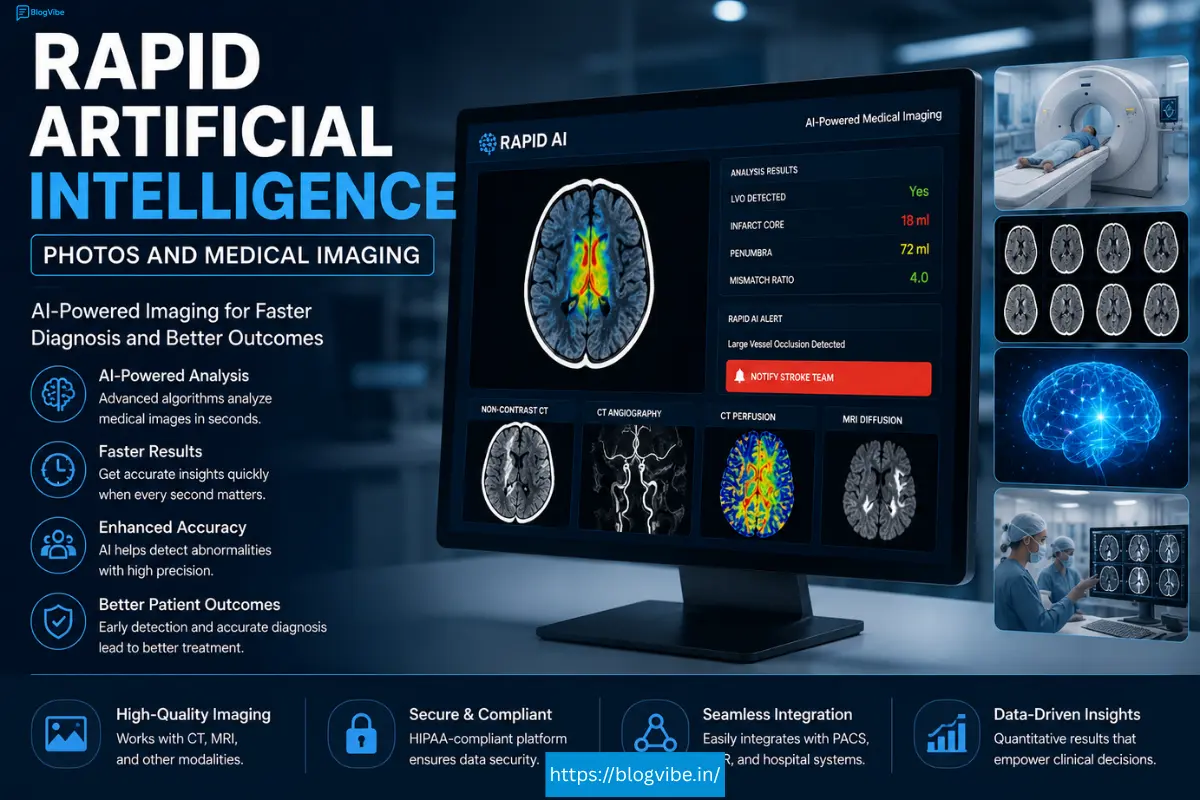
People sometimes search for Rapid Artificial Intelligence photos, expecting product screenshots.
In reality, most publicly available images include:
- Stroke workflow diagrams
- Hospital dashboards
- Clinical interfaces
- Brain scan visualizations
- Educational graphics
Due to patient privacy laws, real clinical images are carefully protected.
Real-World Example
Imagine a patient arrives at an emergency department with sudden weakness on one side.
Without Artificial Intelligence:
- Imaging review takes longer.
- Specialists may wait for reports.
With Rapid Artificial Intelligence:
- Scan completes.
- Artificial Intelligence analyzes images.
- Neurologists receive instant alerts.
- Treatment begins sooner.
Those saved minutes can significantly improve long-term recovery.
Rapid Artificial Intelligence vs Traditional Stroke Imaging
| Feature | Rapid Artificial Intelligence | Traditional Workflow |
| Artificial Intelligence Analysis | Yes | No |
| Automated Detection | Yes | Manual |
| Mobile Alerts | Yes | Limited |
| Workflow Automation | Excellent | Basic |
| Decision Support | Strong | Physician Only |
| Collaboration | Real-time | Slower |
Pros and Cons
Pros
- Fast image analysis
- Supports clinical decisions
- Excellent workflow automation
- Strong hospital integration
- Mobile collaboration
- Trusted by many healthcare organizations
- Expanding Artificial Intelligence capabilities
Cons
- Designed primarily for healthcare organizations
- Requires clinical infrastructure
- Subscription costs may be significant
- Cannot replace physician judgment
- Requires proper implementation and training
Common Mistakes
Many newcomers misunderstand what Rapid Artificial Intelligence actually does.
Avoid these misconceptions:
- Believing Artificial Intelligence replaces doctors
- Assuming results are always perfect
- Ignoring clinical validation
- Confusing it with general Artificial Intelligence image generators
- Overlooking regulatory compliance
Rapid Artificial Intelligence is a clinical decision-support system, not an autonomous diagnostic tool.
Best Practices
If your organization plans to use Rapid Artificial Intelligence:
- Train staff properly.
- Validate workflows regularly.
- Integrate with existing hospital systems.
- Review Artificial Intelligence recommendations alongside clinical judgment.
- Keep software updated.
- Monitor performance metrics.
Developers working with the Rapid Artificial Intelligence API should also prioritize security, authentication, and healthcare compliance.
Frequently Asked Questions
1. What is Rapid Artificial Intelligence used for?
Rapid Artificial Intelligence helps hospitals analyze medical images for stroke and vascular disease diagnosis more quickly.
2. Is Rapid Artificial Intelligence available for personal use?
No. It is primarily designed for hospitals and healthcare organizations.
3. Does Rapid Artificial Intelligence replace radiologists?
No. It assists clinicians by providing decision-support information.
4. What is the Rapid Artificial Intelligence app?
It is a secure mobile application that allows medical teams to receive alerts, review imaging, and collaborate during emergency cases.
5. What does the Rapid Artificial Intelligence API do?
It enables hospitals and developers to integrate Rapid Artificial Intelligence with electronic health record systems and other healthcare platforms.
6. Are Rapid Artificial Intelligence careers suitable for software engineers?
Yes. Engineers specializing in Artificial Intelligence, cloud computing, healthcare IT, and machine learning are in demand.
7. What salary can employees expect?
Compensation varies by role and location but is generally competitive within the healthcare technology industry.
8. Is Rapid AI only for stroke detection?
No. The platform also supports aneurysm, pulmonary embolism, hemorrhage detection, and other vascular conditions.
9. Is Rapid AI FDA-cleared?
Many Rapid Artificial Intelligence clinical products have received regulatory clearances in various markets. Always verify the latest approvals for your region before deployment.
10. Is Rapid AI worth learning about?
Absolutely. As Artificial Intelligence continues transforming healthcare, understanding platforms like Rapid Artificial Intelligence is valuable for clinicians, developers, healthcare administrators, and students.
Conclusion
Rapid AI has become one of the leading Artificial Intelligence-powered medical imaging platforms by helping hospitals diagnose stroke and other vascular conditions faster and more efficiently. Rather than replacing physicians, it enhances clinical workflows with automated image analysis, real-time collaboration, and evidence-based decision support.
For healthcare organizations, the platform can improve emergency response times and streamline communication. For developers, the Rapid Artificial Intelligence API offers opportunities to build connected healthcare systems. And for professionals exploring Rapid Artificial Intelligence careers, the company represents an exciting intersection of artificial intelligence, software engineering, and modern medicine.
As medical AI continues to evolve through 2026 and beyond, Rapid Artificial Intelligence is well-positioned to remain a key technology supporting faster diagnoses and better patient outcomes.
If you’re considering adopting AI in healthcare or building a career in health technology, Rapid Artificial Intelligence is certainly a platform worth understanding.
Key Takeaways
- Rapid Artificial Intelligence is an AI-powered medical imaging platform focused on stroke and vascular care.
- It analyzes CT and MRI scans in minutes to support faster treatment decisions.
- The Rapid Artificial Intelligence software suite includes specialized tools for stroke, hemorrhage, and pulmonary embolism.
- The Rapid Artificial Intelligence app enables secure mobile collaboration for healthcare teams.
- The Rapid Artificial Intelligence API integrates with hospital systems to streamline workflows.
- Rapid Artificial Intelligence Vision uses computer vision to interpret medical imaging, not general photography.
- Rapid Artificial Intelligence careers span engineering, Artificial Intelligence research, clinical support, product management, and sales.
- Salary ranges are competitive, particularly for software and machine learning roles.
- AI supports physicians—it does not replace their clinical judgment.
- As healthcare increasingly adopts artificial intelligence, Rapid Artificial Intelligence remains one of the industry’s most influential clinical imaging platforms.