
AI Robots: Artificial intelligence is transforming industries at lightning speed, and Artificial intelligence Robots are at the center of this revolution. From factory automation to healthcare assistance and even space exploration, these intelligent machines are becoming more capable every year.
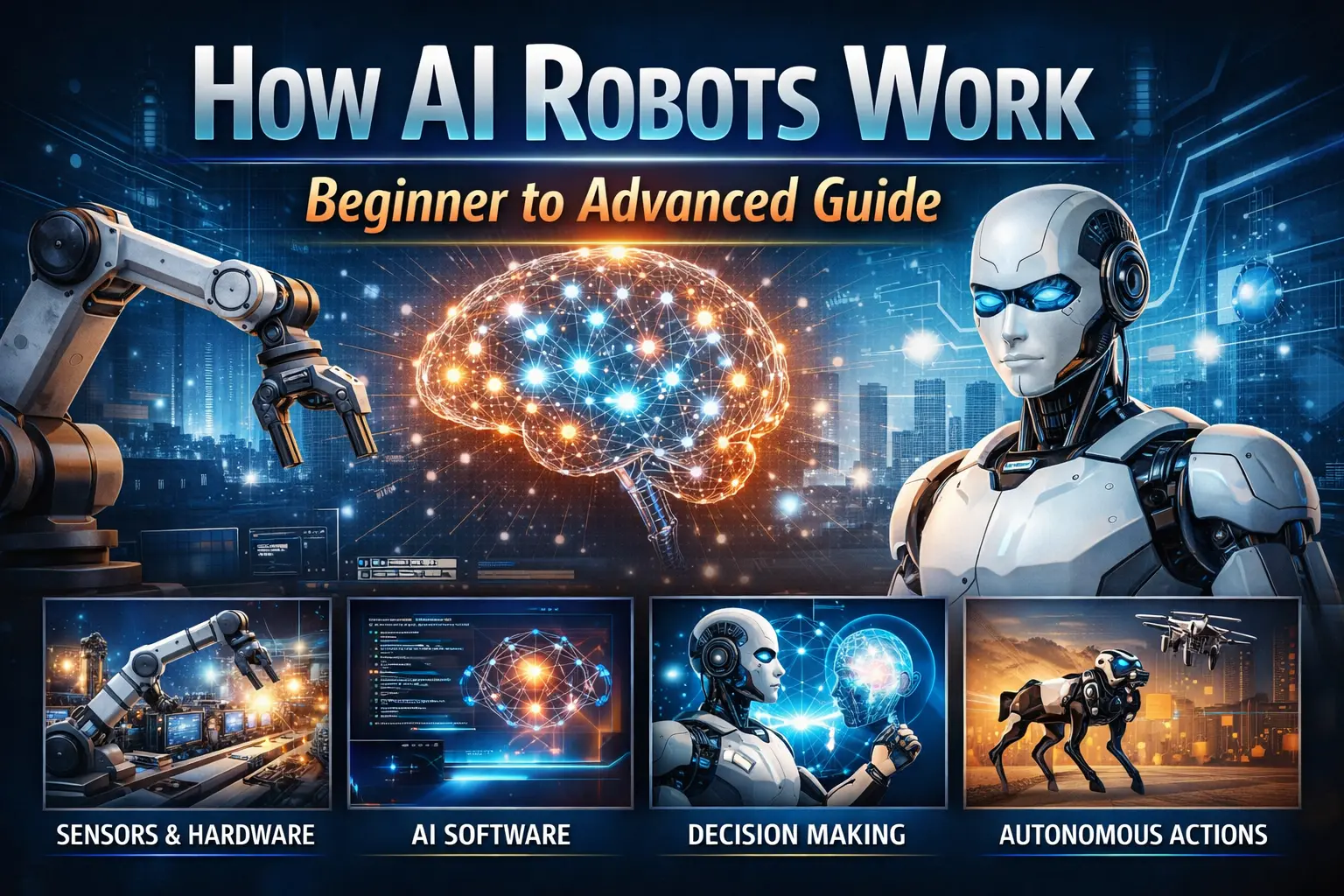
In this beginner-to-advanced guide, you’ll learn exactly how AI Robots work, what technologies power them, and how modern systems like chat gpt v4 and gpt 4 chat influence their intelligence.
What Are AI Robots?
AI Robots are machines that combine physical hardware with artificial intelligence software to perform tasks autonomously or semi-autonomously. Unlike traditional robots that follow fixed instructions, AI-powered robots can:
- Learn from data
- Make decisions
- Adapt to new environments
- Improve performance over time
In simple words, if a normal robot is a machine that follows commands, an AI robot is a machine that can think and learn.
Core Components of Artificial intelligence Robots
To understand how Artificial intelligence Robots work, you need to know their four main building blocks.
1. Sensors – The Robot’s Eyes and Eears
Sensors allow Artificial intelligence Robots to collect information from the environment. Common sensors include:
- Cameras (vision)
- Microphones (sound)
- LiDAR (distance mapping)
- Touch sensors
- Temperature sensors
These sensors convert real-world signals into digital data that Artificial intelligence systems can analyze.
Example: A warehouse robot uses cameras to detect boxes and avoid obstacles.
2. Processing Unit – The Robot’s Brain
This is where artificial intelligence runs. The processor (CPU, GPU, or Artificial intelligence chip) analyzes sensor data and decides what action to take.
Modern robots often use deep learning models similar to those behind open Artificial intelligence chat gpt 4 systems to interpret complex inputs like speech and images.
Key technologies include:
- Machine Learning
- Deep Learning
- Neural Networks
- Computer Vision
- Natural Language Processing
3. Actuators – The Robot’s Muscles
Actuators convert digital decisions into physical movement. They control:
- Wheels
- Robotic arms
- Grippers
- Legs
- Motors
Without actuators, an Artificial intelligence robot could think but not act.
4. Software & Artificial intelligence Models – The Intelligence Layer
This is the most important part of modern AI Robots. Advanced models — similar in architecture to openArtificial intelligence chat gpt 4 and chat gpt 3 4 systems — help robots:
- Understand speech
- Recognize objects
- Plan actions
- Learn from experience
How Artificial intelligence Robots Actually Work
Let’s break down the full workflow in a simple pipeline.
Step 1: Data Collection
Sensors gather raw data from the environment.
Example inputs:
- Image of a room
- Voice command
- Distance measurements
- Object positions
Step 2: Data Processing
The Artificial intelligence model processes the data using trained neural networks.
For instance:
- Computer vision detects objects
- Speech recognition converts voice to text
- Language models interpret commands
This is where technologies similar to gpt 4 chat systems shine.
Step 3: Decision Making
The robot decides what to do next using:
- Rule-based logic
- Reinforcement learning
- Path-planning algorithms
- Predictive models
Advanced Artificial intelligence Robots can evaluate multiple options before acting.
Step 4: Action Execution
Actuators carry out the decision:
- Move forward
- Pick up object
- Avoid obstacle
- Speak response
Step 5: Learning & Improvement
Modern Artificial intelligence Robots improve through:
- Feedback loops
- Reinforcement learning
- Continuous training
This makes them smarter over time — a major leap from traditional automation.
Beginner Level: Simple Artificial intelligence Robots
At the entry level, AI Robots perform narrow tasks.
Examples
- Robot vacuum cleaners
- Line-following robots
- Basic warehouse bots
- Educational robots
Characteristics
- Limited learning ability
- Predefined environments
- Simple sensors
- Low computing power
These robots use lightweight Artificial intelligence models and basic logic.
Intermediate Level: Smart Autonomous Robots
Mid-level AI Robots are much more capable.
Features
- Real-time obstacle avoidance
- Object recognition
- Voice interaction
- Indoor navigation
- Cloud connectivity
Real-World Examples
- Delivery robots
- Smart home assistants
- Agricultural robots
- Security patrol bots
These systems often integrate cloud AI services similar to open ai chat gpt4-style language processing for voice commands.
Advanced Level: Fully Intelligent Artificial intelligence Robots
This is where things get exciting.
Advanced Artificial intelligence Robots combine multiple AI domains:
- Computer vision
- Natural language understanding
- Motion planning
- Reinforcement learning
- Multimodal AI
Capabilities
- Human-like conversation
- Complex task planning
- Adaptive learning
- Collaborative work with humans
- Autonomous exploration
Role of Large Language Models in Artificial intelligence Robots
Modern AI Robots are increasingly powered by large language models (LLMs).
Systems inspired by chat gpt 4 parameters and similar architectures allow robots to:
- Understand natural language
- Follow complex instructions
- Generate responses
- Assist humans conversationally
Why This Matters
Earlier robots could only follow buttons and scripts. Now robots can:
- Take voice commands
- Answer questions
- Explain actions
- Learn from text data
This dramatically improves human-robot interaction.
Real-World Applications of Artificial intelligence Robots
AI Robots are already transforming multiple industries.
Manufacturing
- Automated assembly
- Quality inspection
- Predictive maintenance
Healthcare
- Surgical assistance
- Patient monitoring
- Hospital delivery robots
Logistics
- Warehouse automation
- Last-mile delivery
- Inventory management
Agriculture
- Crop monitoring
- Precision spraying
- Autonomous tractors
Home & Personal Use
- Robot vacuum cleaners
- Elderly care robots
- Smart assistants
Benefits of Artificial intelligence Robots
AI Robots offer major advantages.
Higher Efficiency
They work 24/7 without fatigue.
Improved Accuracy
AI reduces human error in repetitive tasks.
Cost Savings (Long Term)
Automation lowers operational costs.
Enhanced Safety
Robots handle dangerous environments.
Scalability
Easy to deploy across large operations.
Challenges and Limitations
Despite rapid progress, AI Robots still face hurdles.
High Development Cost
Advanced hardware and AI training are expensive.
Data Dependency
AI performance depends heavily on quality data.
Safety & Ethics
Autonomous decision-making raises concerns.
Limited General Intelligence
Most robots are still task-specific.
Power Consumption
Mobile robots struggle with battery life.
Future of Artificial intelligence Robots
The next decade will be transformative.
Emerging Trends
- Humanoid robots
- Artificial intelligence-powered companions
- Swarm robotics
- Edge Artificial intelligence processing
- Multimodal intelligence
- Self-learning systems
With rapid improvements in models similar to open ai chat gpt 4, robots will become more conversational, adaptive, and human-aware.
Experts predict that Artificial intelligence Robots will soon work alongside humans in everyday environments — not just factories.
Expert Tips for Beginners
If you want to enter the Artificial intelligence robotics field:
- Learn Python programming
- Study machine learning basics
- Explore computer vision
- Practice with Arduino or Raspberry Pi
- Understand robotics fundamentals
- Experiment withArtificial intelligence APIs
Starting small and building projects is the fastest way to learn.
Conclusion
Artificial intelligence Robots represent one of the most powerful technological shifts of our time. By combining sensors, intelligent software, and mechanical systems, these machines can perceive, think, and act in the real world.
From simple household helpers to advanced autonomous systems, Artificial intelligenceRobots are becoming smarter every year — especially with the rise of large language models and conversational Artificial intelligence
If current progress continues, the line between humans and intelligent machines will become increasingly blurred in the coming decade.
FAQ – AI Robots
1. What are Artificial intelligence Robots in simple words?
Artificial intelligence Robots are machines that use artificial intelligence to sense their environment, make decisions, and perform tasks automatically without constant human control.
2. How are Artificial intelligence Robots different from normal robots?
Normal robots follow fixed instructions, while Artificial intelligence Robots can learn from data, adapt to new situations, and make decisions using machine learning.
3. Do Artificial intelligence Robots use ChatGPT technology?
Many modern robots integrate language models inspired by systems like gpt 4 chat to enable voice interaction and natural conversation with humans.
4. Where are Artificial intelligence Robots used today?
They are widely used in manufacturing, healthcare, logistics, agriculture, security, and smart homes.
5. Will Artificial intelligence Robots replace human jobs?
Artificial intelligence Robots will automate some repetitive jobs but will also create new roles in Artificial intelligence development, robotics maintenance, and human-robot collaboration.