
OpenFuture AI: Mission, Vision, Importance and Key Points You Should Know: You can all see that AI is employed in apps for study or exploration. It is changing tech companies, jobs, and economies all around the world. AI apps are being used in all fields to quickly gather content, pictures, and adjustments.
Even people who know a lot about big data are utilizing AI to help them see data. This is where the idea of OpenFuture AI comes from as a way to change things. It indicates not only a professional attitude, but also a move toward making AI more accessible to everyone. Taking the Data Science and AI Course Online to learn more about AI methods is a wise choice for your profession.
What is OpenFuture AI? Find out everything you need to know.
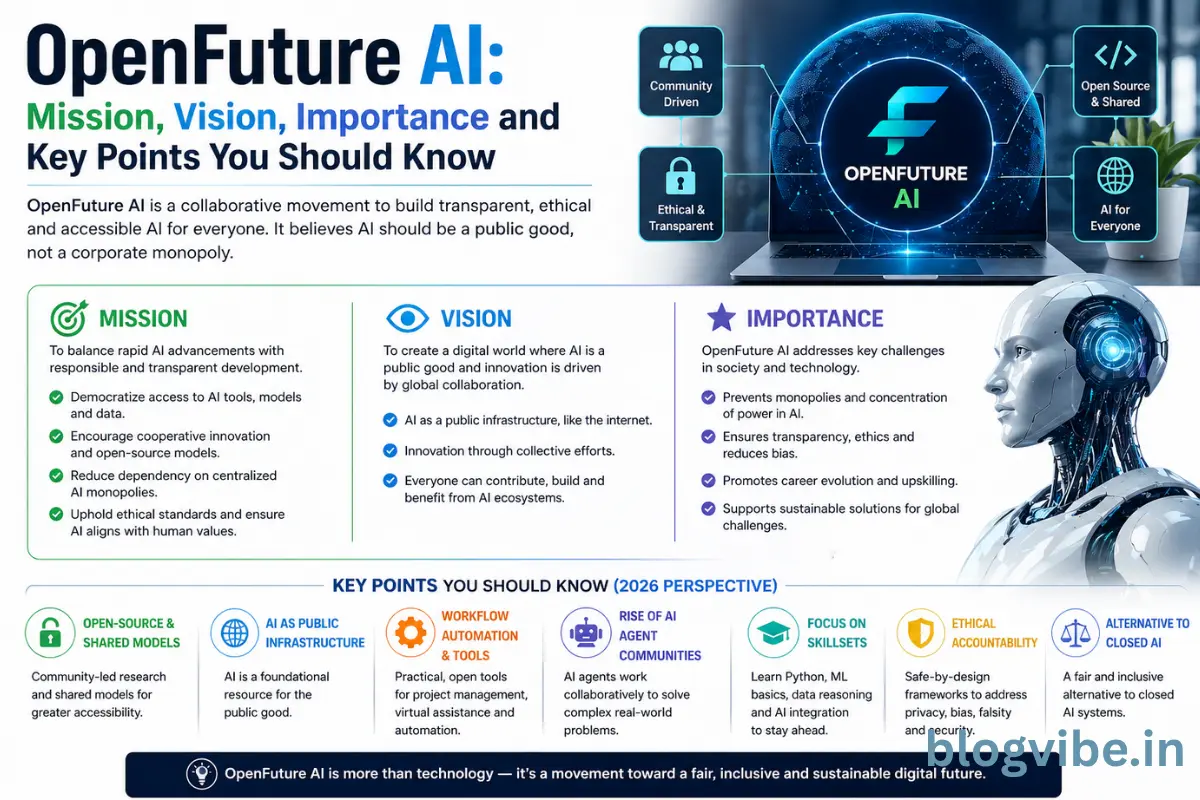
OpenFuture AI is a way of thinking and a place that promotes the development of AI that is open, friendly, and easy to work with. OpenFuture AI is different from most open-source AI systems, which are run by a small number of companies. It supports:
- Open-source AI models
- Shared research and change
- Community-led administration
- Ethical and accountable AI structures
In essence:
OpenFuture AI is about making sure that AI stays a shared resource and not a single agent.
This efficiency is clear in new AI programs like ChatGPT and Gemini, which are changing how people talk to each other and share information online. Users are getting direct, contextual replies from AI agents that are part of search engines and apps instead of the conventional keyword-based searches.
These agents figure out what you want, bring together information from many sources, and send structured answers. This turns search engines into creative helpers.
AI apps today are overly smart since they use safe and encrypted data apps.
The goal of OpenFuture AI
OpenFuture AI’s job is to find a balance between how to use AI and how to make sure it grows in a responsible way. It wants to:
- Make AI tools easy for people and enterprises to use.
- Encourage people from different societies to work together to come up with new ideas.
- Reduce reliance on top AI systems
- Uplift parts, clear work, and accountability
This mission joins with the increasing need to balance innovation with ethical responsibility.
OpenFuture AI’s Vision
The vision behind OpenFuture AI is to devise a world where:
- AI operations as a public good, aligned with the internet
- Innovation is compelled by global collaboration, not limited access
- Individuals from all domains can gain, build, and help AI ecosystems
This vision challenges the dominance of independent AI ecosystems. This opens pathways for more extensive participation in AI development.
Why OpenFuture AI Matters Right Now!
The organization of OpenFuture AI is fault-finding. As AI adoption quickens, several concerns are becoming more prominent:
1. Centralization of AI Agent
A few businesses control progressive AI models, limiting approach and innovation.
2. Rising AI Dependency
People are relying more on AI tools.
3. Moral Concerns
Bias, falsity, and misuse of AI demand accountable structures.
4. Career Shift or Pathways
AI is not replacing jobs. It is changing them swiftly. It is creating a huge work demand for skillful experts who can actually work.
This is the main reason learning AI today is main.
The job advertisement is developing, and those who upskill in AI tools and sciences are attaining a clear career benefit.
OpenFuture AI as a List of AI Tools
OpenFuture AI is not just a concept or set of principles—it also functions as a practical hub for discovering AI-powered tools. It serves as a curated directory where users can explore solutions such as project management tools, time-tracking systems, document collaboration platforms, and virtual assistants.
By bringing these tools together in one place, OpenFuture AI becomes a central resource for improving productivity and streamlining workflows. It is especially valuable for teams and professionals who want to integrate AI into their daily operations.
Key Features of OpenFuture AI
1. Philosophy and Advocacy
OpenFuture AI promotes a vision centered on openness and collaboration. Its core principles include:
- Open research
- Shared AI models
- Community governance
These values ensure that AI systems remain transparent, fair, and accessible to everyone.
2. AI as Public Infrastructure
One of the most powerful ideas behind OpenFuture AI is treating artificial intelligence as public infrastructure—similar to roads or the internet. This approach:
- Reduces monopoly control by large corporations
- Encourages equal access to technology
- Supports innovation at a global scale
3. Automation and Workflow Integration
OpenFuture AI also plays a significant role in technical and creative fields, especially in automation. For example, in platforms like Unreal Engine, AI tools can:
- Automate blueprint creation
- Simplify development workflows
- Improve overall productivity
This highlights how AI is becoming deeply integrated into both creative and technical industries.
4. An Alternative to Closed AI Systems
Many closed AI systems limit access and lack transparency. OpenFuture AI offers a more open and inclusive alternative by:
- Supporting open ecosystems
- Reducing bias through diverse contributions
- Encouraging fair and balanced technological progress
OpenFuture AI Tools for Work and Operations
One of the most useful real-world applications of OpenFuture AI is automating workflows, especially in development environments. With the help of AI, specialists can:
- Make boring or uninteresting work duties automatic
- Make development pipelines better
- Lower the number of mistakes made by hand
- Make things work better in real time
AI can do the following in Blueprint coding environments:
- Give ideas on logical structures
- Make node connections automatic
- Make it easier to fix problems
This is very useful for builders who work on game design, simulations, and common systems.
What Are the 5 Best AI Models Right Now?
To understand the OpenFuture AI ecosystem, you need to think about the most important AI models that are changing the field:
- Gemini,
- Claude,
- LLaMA,
- Mistral,
- ChatGPT
These models highlight the difference between closed and open AI ecosystems, making OpenFuture AI even more important.
Career Perspective: Why Learning AI Is a Good First Step
The fast growth of AI tools has made advertising work much more difficult. People are afraid that AI will take their jobs, but that’s not true. It’s skilled professionals who use AI who are. These tools:
- Basic skills are no longer enough.
- AI knowledge should be a must.
- Professionals must follow workflows that AI requires.
AI is a great tool for dealing with global problems including climate change, resource management, and major events. It can help with smart city planning, improve energy use, see environmental risks, and increase agricultural output. In a world where things are happening in a sustainable way, AI allows for data-driven accountability that balances making money with being kind to the environment. Also, as tech companies try to go digital, the need for AI experts who can create, maintain, and protect AI systems will expand quickly.
People who are against AI won’t shape the future; people who work with advanced AI to tackle hard problems will.
The Real Benefits of Learning New AI for Your Career
- More potential for higher pay
- Access to hope around the world
- Ability to automate tasks
- More output
OpenFuture AI helps with this by offering easy-to-understand events for learning and progress.
True Market Skills You Should Focus On
To thrive in the OpenFuture AI setting, focus on:
- Register for Python
- The basics of machine learning
- Bringing together AI apps
- Reasoning with data
- Industrialization of workflow
New Scope or Outlook
The future of AI seems bright and exciting:
- Working together openly
- Change that isn’t centralized
- Government that is moral
- Computerization that can grow
OpenFuture AI is at the heart of this change, moving us toward a world where:
- AI is easy for everyone to use. Innovation is a group effort.
- Growth is complete.
The End
OpenFuture AI is more than just a technological movement; it’s a move toward an AI ecosystem that is more fair and open. It fights the problems with closed AI systems by promoting an open approach, app development, and ethical behavior.
The best AI tools of 2026 aren’t only about new AI technologies; they can also help you get forward in your job. They are changing the way people conduct their jobs, create content, and run their businesses.
The road forward is simple for beginners, learners, and experts: use generative AI, gain experience, and remain ahead of the curve.
In today’s digital economy, people who study AI in Data Science Training in Delhi will not be replaced by AI; they will be in charge of it.
FAQs About OpenFuture AI
1. What is OpenFuture AI in simple terms?
OpenFuture AI is a way of making artificial intelligence that is open and collaborative. It emphasizes on being open, sharing work, and giving everyone the same access, instead than being controlled by a few big firms.
2. How is OpenFuture AI different from traditional AI systems?
OpenFuture AI is different from closed AI systems made by private companies since it supports open-source models, community involvement, and public access. This makes AI more fair and clear.
3. Why is OpenFuture AI important in 2026?
AI will be a big part of everyday life by 2026. OpenFuture AI stops monopolies, makes sure that AI is used ethically, and lets more people throughout the world benefit from AI technology.
4. Who can benefit from OpenFuture AI?
Students, developers, businesses, freelancers, and researchers can all benefit from OpenFuture AI by accessing tools, learning resources, and collaborative opportunities.
5. What skills are needed to work with OpenFuture AI?
Some important skills are knowing how to use Python to write code, how to use machine learning, how to analyze data, and how to use AI tools in real life.
Read more: Gemini’s Multimodal Evolution: What It Means for AI Video Making