
Artificial intelligence is changing the world very fast. One of the most exciting results of this technology is the AI ROBOT.
Today, AI robots work in factories, hospitals, homes, and even space missions. They can see, learn, and make decisions with very little human help.
But what exactly is an AI ROBOT? How does it work? And why is it so important for the future?
In this complete guide, you will learn everything about AI robots in simple words.
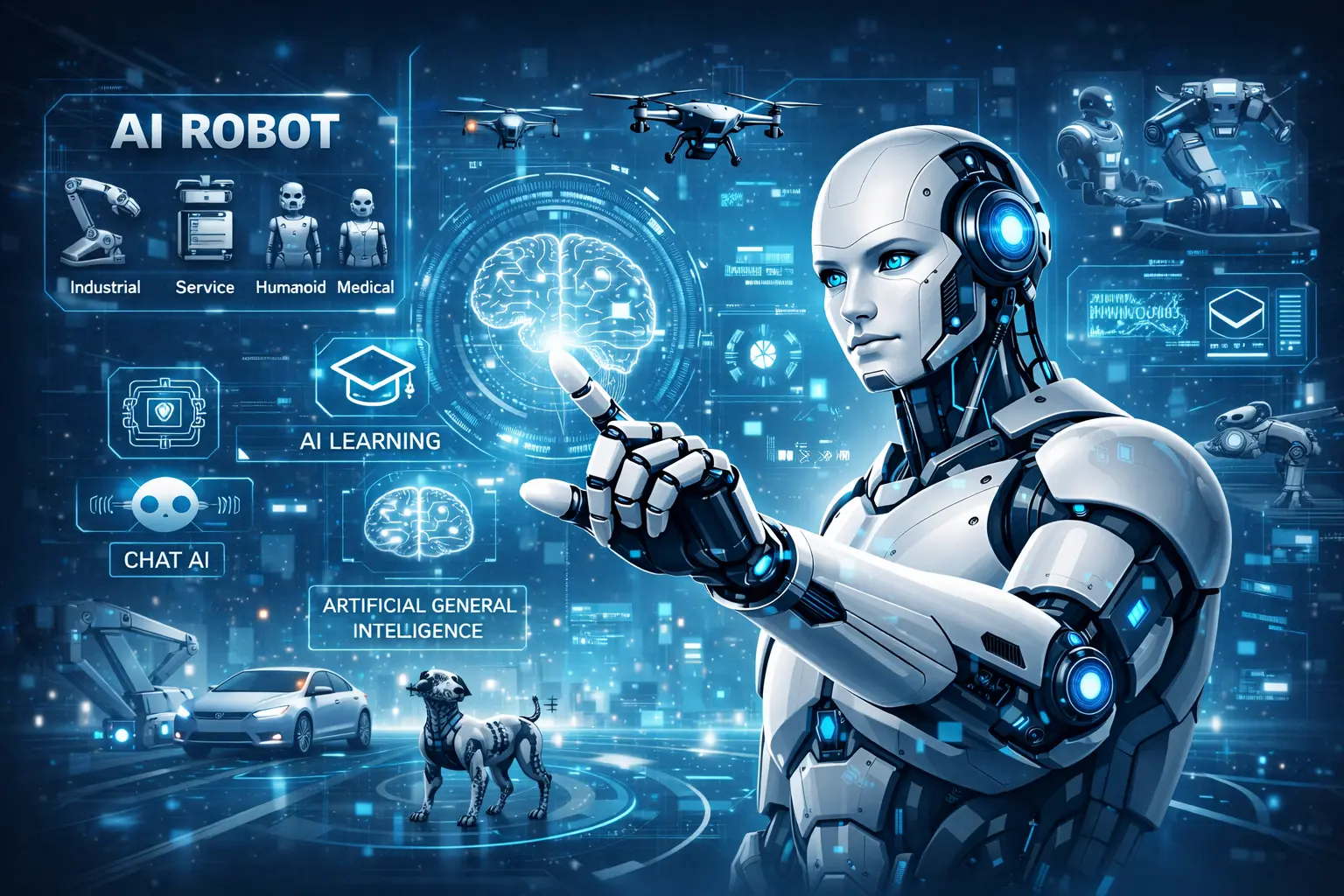
What is an AI ROBOT?
An AI ROBOT is a smart machine that uses artificial intelligence to perform tasks automatically.
Unlike traditional robots, AI robots can:
Learn from data
Understand their environment
Make decisions
Improve over time
In simple terms:
A normal robot follows fixed rules.
An AI robot can learn and adapt.
This ability makes AI robots much more powerful and useful.
How Does an Artificial intelligence ROBOT Work?
1. Sensors — The Eyes and Ears
Sensors help the robot collect information from the world. These include cameras, microphones, and touch sensors.
2. AI Brain — The Thinking System
The robot processes data using AI models, similar to tools created by OpenAI. This helps the robot understand speech, images, and patterns.
3. AI Learning — Getting Smarter
With AI learning, the robot improves from experience. The more data it gets, the better it performs.
4. Actuators — The Body
Actuators help the robot move, grab objects, or perform physical work.
Types of Artificial intelligence ROBOT
Artificial intelligence robots come in many forms depending on their purpose.
1. Industrial Artificial intelligence Robots
These robots work in factories and manufacturing units.
Examples:
- Assembly line robots
- Welding robots
- Packaging robots
They increase speed, accuracy, and productivity.
2. Service Artificial intelligence Robots
Service robots assist humans in daily tasks.
Examples:
- Hotel reception robots
- Cleaning robots
- Delivery robots
Many companies are integrating AI chat features to make these robots more interactive.
3. Humanoid Artificial intelligence Robots
Humanoid robots look and behave like humans.
Key features:
- Human-like face and body
- Speech recognition
- Emotional interaction
These robots often use chatbot AI systems similar to chat gpt online tools to communicate naturally.
4. Medical Artificial intelligence Robots
Healthcare is one of the fastest-growing areas for Artificial intelligence robots.
Uses include:
- Robotic surgery
- Patient monitoring
- Medicine delivery
- Elderly care assistance
They help doctors improve precision and patient outcomes.
5. Autonomous Artificial intelligence Robots
These robots operate without human control.
Examples:
- Self-driving vehicles
- Drone delivery systems
- Agricultural robots
They rely heavily on AI learning and real-time data processing.
Role of Artificial General Intelligence in Artificial intelligence Robots
Today’s AI robots are mostly narrow Artificial intelligence, meaning they perform specific tasks. However, researchers are working toward artificial general intelligence (AGI).
AGI aims to create machines that can:
- Understand any intellectual task
- Reason like humans
- Learn across multiple domains
When AGI becomes practical, the Artificial intelligence ROBOT could become far more capable and autonomous than today’s machines.
Artificial intelligence Chat and Conversational Robots
One major advancement is the integration of Artificial intelligence chat systems into robots.
Modern chatbot Artificial intelligence technologies allow robots to:
- Understand natural language
- Answer questions
- Provide customer support
- Hold human-like conversations
Platforms inspired by tools like chatgpt openai systems and c ai conversational models are pushing robots toward more natural communication.
Major Companies Working on Artificial intelligence Robots
Several tech leaders are driving innovation in the AI ROBOT space.
Meta Artificial intelligence
Meta AI focuses on advanced machine learning, computer vision, and embodied AI research that supports next-generation intelligent robots.
Midjourney
While Midjourney is primarily known for Artificial intelligence image generation, its visual intelligence research contributes to the broader AI ecosystem that benefits robotics perception systems.
These organizations, along with many startups, are accelerating the development of smarter Artificial intelligence robots.
Real-World Applications of Artificial intelligence ROBOT
Artificial intelligence robots are already transforming multiple industries.
Manufacturing
- Automated assembly
- Quality inspection
- Predictive maintenance
Healthcare
- Robotic surgery
- Hospital assistance
- Rehabilitation support
Agriculture
- Crop monitoring
- Automated harvesting
- Precision farming
Customer Service
- Artificial intelligence chat kiosks
- Reception robots
- Virtual assistants
Home Automation
- Smart vacuum robots
- Personal assistant robots
- Security patrol robots
Benefits of AI ROBOT
Artificial intelligence robots offer powerful advantages across sectors.
Increased Efficiency
Artificial intelligence robots work 24/7 without fatigue, significantly improving productivity.
Higher Accuracy
Machine precision reduces human error, especially in manufacturing and surgery.
Cost Savings
Although initial investment is high, long-term operational costs often decrease.
Improved Safety
Artificial intelligence robots can perform dangerous tasks such as:
- Mining
- Bomb disposal
- Hazardous inspections
Better Customer Experience
With advanced Artificial intelligencechat capabilities, robots can provide instant support and personalized interactions.
Challenges and Limitations
Despite their promise, Artificial intelligence robots face important challenges.
High Development Cost
Building and deploying advanced Artificial intelligence robots is still expensive.
Ethical Concerns
Issues include:
- Job displacement
- Privacy risks
- Autonomous decision-making
Technical Limitations
Current Artificial intelligence robots still struggle with:
- Complex reasoning
- Emotional understanding
- Unpredictable environments
Dependence on Data
Artificial intelligence learning requires large amounts of high-quality data. Poor data leads to poor performance.
Future of Artificial intelligence ROBOT Technology
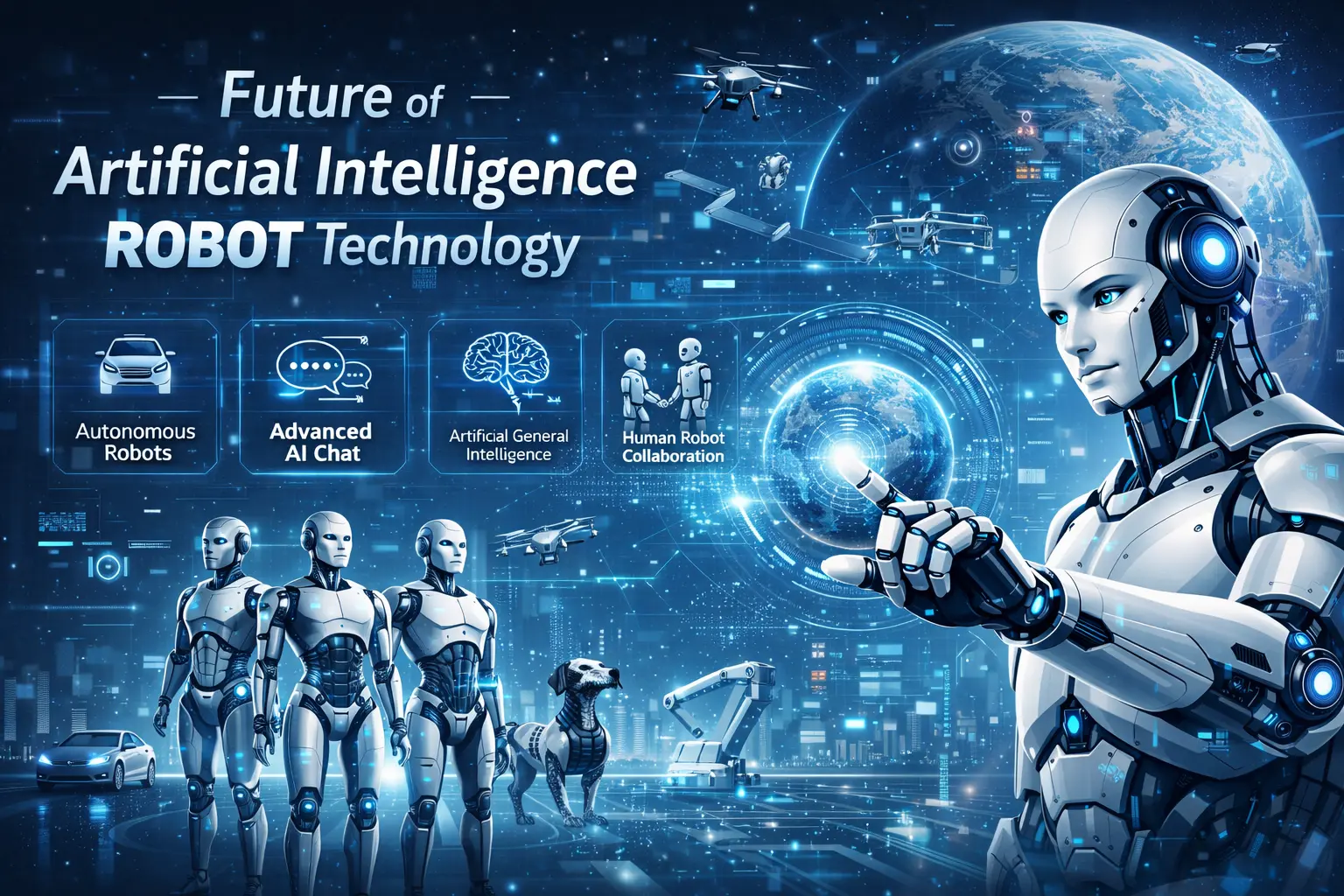
The future of AI robots looks extremely promising.
Short-Term (Next 5 Years)
- Smarter home robots
- Better Artificial intelligence chat integration
- More warehouse automation
- Improved humanoid movement
Medium-Term (5–15 Years)
- Advanced autonomous vehicles
- Highly capable service robots
- Near-human conversational ability
- Wider adoption in healthcare
Long-Term (AGI Era)
If artificial general intelligence becomes reality, future Artificial intelligence robots may:
- Think independently
- Learn like humans
- Perform multiple complex jobs
- Collaborate seamlessly with people
This could redefine how humans work and live.
How to Start Learning About Artificial intelligence Robots
If you’re interested in entering this field, start with these steps:
- Learn basic Artificial intelligence learning and machine learning
- Study robotics fundamentals
- Practice with simple chatbot Artificial intelligence projects
- Explore computer vision
- Build small automation projects
Many beginners start by experimenting with chat gpt online tools and gradually move toward robotics programming.
Questions (FAQ)
What is the difference between a robot and an Artificial intelligence ROBOT?
A normal robot follows fixed instructions, while an Artificial intelligence ROBOT can learn, adapt, and make decisions using artificial intelligence.
Are Artificial intelligence robots dangerous?
Most Artificial intelligence robots are designed with strict safety controls. Risks mainly arise from misuse or poor system design.
Can Artificial intelligence robots replace human jobs?
AI robots may automate repetitive tasks, but they also create new jobs in AI development, maintenance, and robotics engineering.
Is artificial general intelligence available today?
No, AGI is still in the research stage. Current AI robots use narrow AI designed for specific tasks.
How are Artificial intelligence chat systems used in robots?
Artificial intelligence chat allows robots to understand human language, answer questions, and provide interactive support in real time.
Conclusion
The Artificial intelligence ROBOT represents one of the most exciting technological advancements of our time. By combining robotics with artificial intelligence, these machines are becoming smarter, more adaptive, and increasingly useful across industries.
From manufacturing and healthcare to customer service and home automation, AI robots are already reshaping the modern world. While challenges like cost, ethics, and technical limitations remain, ongoing progress in AI learning and artificial general intelligence research suggests a future where intelligent robots become deeply integrated into everyday life.
For students, developers, and entrepreneurs, now is the perfect time to understand and explore the rapidly evolving world of AI robots—the technology that is truly defining the future.
Gemini AI Photo Prompt Copy Paste Trending Boy