
AI Use Cases in B2B Commerce: are changing how manufacturers, wholesalers, distributors, and other B2B companies manage sales, orders, customer service, inventory, pricing, and product data.
Unlike traditional ecommerce, B2B commerce often involves large product catalogs, customer-specific pricing, purchase orders, contracts, multiple decision-makers, and complicated workflows. This makes AI particularly useful for automating repetitive work and helping teams make faster decisions.
In 2026, businesses are moving beyond basic AI chatbots. AI is increasingly being used for order automation, demand forecasting, product search, sales intelligence, pricing, content generation, fraud detection, and AI agents.
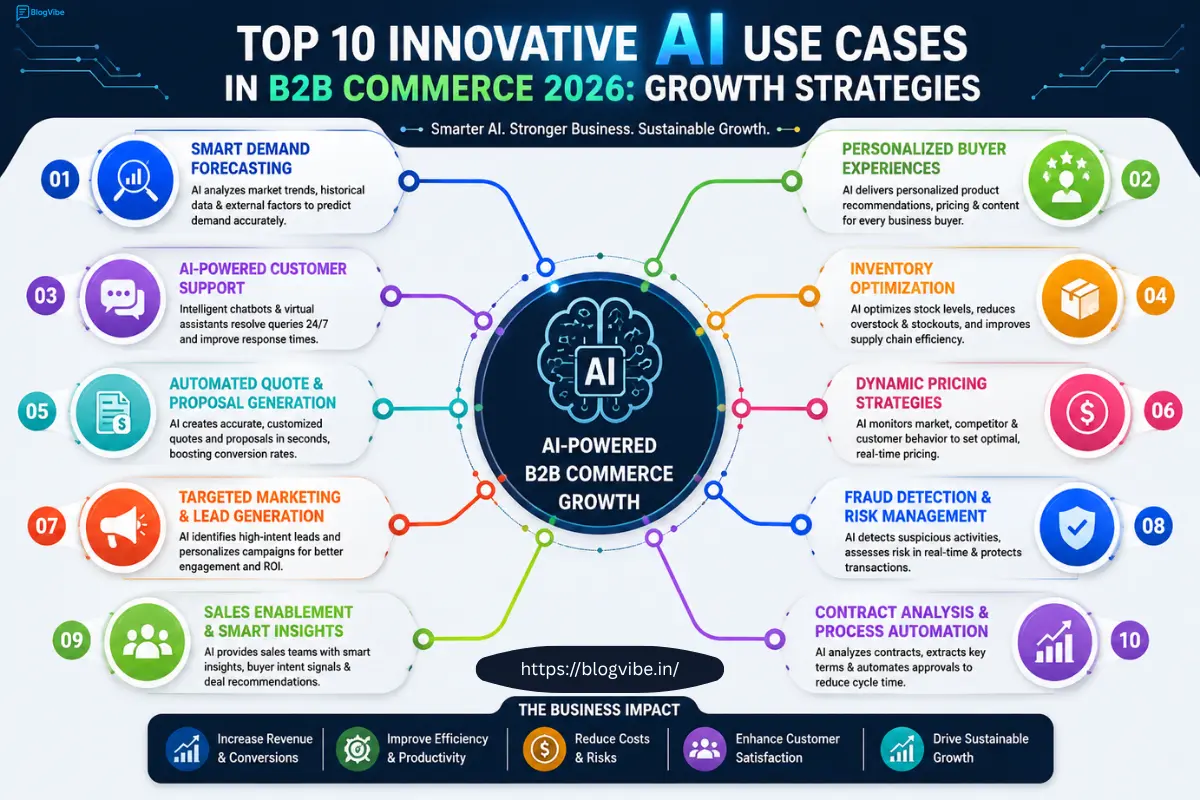
In this guide, let’s look at 10 practical AI use cases in B2B commerce and how businesses can use them.
What Is AI in B2B Commerce?
AI in B2B commerce means using artificial intelligence to improve different parts of the buying and selling process between businesses.
For example, a distributor might use AI to read a purchase order received as a PDF, extract the product numbers and quantities, and create a draft order for an employee to review.
Another company might use AI to help customers find products, answer order-status questions, forecast demand, or identify sales opportunities.
The main goal is not simply to “use AI.” The goal is to reduce repetitive work, improve accuracy, and make B2B buying and selling easier.
10 AI Use Cases in B2B Commerce
1. AI-Powered Order Processing
One of the most practical AI use cases in B2B commerce is order automation.
B2B purchase orders can arrive through emails, PDFs, spreadsheets, or other documents. Traditionally, an employee may have to manually read the document and enter product SKUs, quantities, customer information, and shipping details into an ERP or ecommerce system.
AI can help automate much of this process.
An AI-powered system can:
- Read PDFs and documents
- Extract product information
- Identify SKUs and quantities
- Match customer information
- Detect possible errors
- Create a draft order
- Send unusual cases to a human for review
This can reduce repetitive data-entry work and allow sales teams to spend more time helping customers.
OroCommerce identifies order automation and document processing as one of the most established B2B AI applications, particularly because the workflow involves repetitive, structured tasks.
Example:
A wholesale company receives hundreds of purchase orders by email every week. Instead of manually entering every line, AI extracts the information and prepares orders for employee approval.
2. AI Customer Service and Support
Customer service is another important area where AI in B2B commerce can be useful.
B2B customers often ask repetitive questions such as:
- Where is my order?
- Is this product available?
- What is the price?
- What are the product specifications?
- When can you deliver it?
- Can I reorder this product?
An AI assistant can answer many routine questions using connected business data.
For example, an AI customer-service system could check an order-status system and provide the latest information to a customer.
More complicated requests can still be transferred to a human employee.
This approach allows companies to automate simple support requests while keeping human employees involved when judgment or account-specific decisions are required.
3. AI Demand Forecasting and Inventory Optimization
Poor inventory planning can create two major problems:
Too much inventory means money gets tied up in stock.
Too little inventory can lead to stockouts and missed sales.
AI demand forecasting can analyze historical sales and other business data to identify patterns that may help companies plan inventory.
Depending on the system and available data, AI can analyze:
- Previous sales
- Seasonal patterns
- Customer buying behavior
- Product demand
- Promotions
- Inventory levels
- Other business signals
The resulting forecasts can help teams make better inventory-planning decisions.
AI demand forecasting is now a major ecommerce application, although its usefulness depends heavily on the quality and quantity of available data.
Example:
A B2B distributor can use historical purchasing patterns to identify products that are likely to experience higher demand during a particular season.
4. AI Product Search and Discovery
Large B2B catalogs can contain thousands or even millions of products.
Finding the right product isn’t always easy.
A traditional search system may struggle when a buyer doesn’t know the exact product name or SKU.
AI-powered search can understand natural-language queries and product relationships better.
For example, instead of searching for an exact SKU, a buyer could type:
“I need a stainless steel valve suitable for high-pressure applications.”
An AI-powered search system can potentially understand the intent and return more relevant products.
This is particularly useful for businesses with large catalogs and complex product information. AI-powered product discovery is increasingly becoming part of modern B2B ecommerce experiences.
5. AI Sales Intelligence and Lead Scoring
Sales teams often have more leads and customer information than they can manually analyze.
AI can help sales teams identify patterns in customer behavior and prioritize opportunities.
For example, an AI system can analyze:
- Previous purchases
- Website activity
- Customer interactions
- Order frequency
- Account information
- Sales pipeline activity
It can then help sales representatives identify which accounts may need attention.
This doesn’t mean AI should automatically make every sales decision. Instead, it can act as a sales assistant that helps representatives focus their time.
AI-powered sales intelligence is also becoming an important part of the broader shift toward AI-assisted B2B sales. McKinsey’s 2026 B2B research describes agentic AI and AI-supported commercial workflows as an emerging part of how sales organizations are changing their processes.
6. AI-Powered Personalization
B2B customers don’t always want the same products, prices, or recommendations.
A manufacturer may have different product requirements from a retailer. A large customer may also have different pricing or purchasing patterns from a smaller account.
AI can use customer and account data to create more relevant experiences.
For example, an ecommerce portal could show:
- Frequently purchased products
- Related products
- Reorder suggestions
- Account-specific recommendations
- Relevant product categories
AI personalization can therefore make large B2B catalogs easier to navigate.
SAP notes that B2B sellers are increasingly using AI to address buyer expectations around personalization while managing complex catalogs, pricing structures, and supply-chain operations.
7. AI Dynamic Pricing and Pricing Optimization
B2B pricing can be much more complicated than standard retail pricing.
Prices may depend on:
- Customer type
- Order quantity
- Contract terms
- Volume discounts
- Product margins
- Previous agreements
- Market conditions
AI can analyze pricing data and help businesses identify patterns or pricing opportunities.
For example, AI could help a sales team understand how different discount levels have affected previous deals.
However, pricing is a sensitive business function. AI recommendations should generally operate within clearly defined rules and approval processes rather than being allowed to change important commercial terms without oversight.
Dynamic pricing and pricing optimization are among the AI applications being explored in B2B ecommerce.
8. AI Product Content and Catalog Management
B2B companies can have huge product catalogs.
Each product may require:
- Product descriptions
- Specifications
- Attributes
- Categories
- Technical information
- Search keywords
- Images or supporting content
Creating and maintaining all this information manually can take a lot of time.
Generative AI can help teams create or improve product descriptions, organize information, identify missing attributes, and prepare content for different channels.
Human review is still important, especially for technical specifications and regulated products.
The benefit is that AI can help employees handle the repetitive parts of catalog management faster.
Product-data enrichment and content generation are already identified as practical B2B AI applications.
9. AI Fraud Detection and Risk Management
B2B businesses process many transactions and may deal with different customers, payment methods, and account structures.
AI can help identify unusual patterns that may require additional investigation.
For example, an AI system could flag:
- Unusual transaction behavior
- Unexpected purchasing patterns
- Suspicious account activity
- Abnormal payment behavior
- Potential fraud signals
AI doesn’t automatically mean every flagged transaction is fraudulent. Instead, it can help risk teams identify transactions that deserve closer attention.
Fraud detection is one of the established AI application areas across ecommerce, including B2B environments.
10. AI Agents and Agentic Commerce
AI agents are one of the most interesting developments in AI in B2B ecommerce in 2026.
Traditional AI might answer:
“Your order is scheduled for delivery tomorrow.”
An AI agent can potentially go further by performing actions inside connected systems.
For example, an AI agent could assist with:
- Finding a product
- Checking availability
- Preparing a quote
- Creating an order
- Checking order status
- Handling a service request
The key difference is action.
A normal AI assistant mainly provides information or recommendations. An agentic system is designed to complete tasks through connected tools and workflows.
BigCommerce describes agentic commerce as an emerging direction in which AI can participate in workflows such as quoting, ordering, and service.
However, companies need strong data, permissions, security controls, and human oversight before allowing AI agents to perform important commercial actions.
AI in B2B Commerce: Which Use Case Should You Start With?
Not every company should try to implement all 10 use cases at once.
A better approach is to start with a repetitive process that has:
- Clear business rules
- Good-quality data
- A measurable outcome
- Reasonable implementation risk
- Human oversight
For example, a company receiving thousands of purchase orders every month may first investigate AI order processing.
A business with a large product catalog may instead start with AI search and product discovery.
A company struggling with repetitive customer questions might investigate AI customer service.
The important point is that AI tools alone don’t guarantee results. Data quality and connected business systems matter significantly. BigCommerce and other B2B ecommerce sources emphasize digital maturity, clean data, connected systems, and workflow design as important factors in successful AI implementation.
Benefits of AI in B2B Ecommerce
When implemented correctly, AI can help B2B companies in several areas.
1. Less Manual Work
AI can automate repetitive tasks such as document processing, data entry, and routine customer questions.
2. Faster Operations
Automated workflows can reduce the time required to process common requests.
3. Better Product Discovery
AI-powered search can help buyers find relevant products more easily.
4. Better Customer Experience
Personalized recommendations and AI-assisted support can make digital buying easier.
5. Data-Driven Decisions
AI can analyze large amounts of business data and identify patterns that may be difficult to spot manually.
6. Scalable Operations
AI can help businesses handle increasing volumes of customers, orders, and product data without increasing every manual process at the same rate.
Challenges of Using AI in B2B Commerce
AI isn’t a magic solution.
B2B companies should consider several challenges before implementation.
Data Quality
If product, customer, inventory, or pricing data is inaccurate, AI outputs can also be unreliable.
Integration
AI often needs access to systems such as:
- ERP
- CRM
- Ecommerce platform
- Inventory system
- Product information management system
Security
Companies need to control what information AI systems can access and what actions they are allowed to perform.
Human Oversight
Important pricing, orders, financial decisions, and customer-specific actions may require human review.
Implementation Cost
Some advanced AI systems require significant technical work, integrations, and ongoing maintenance.
That’s why starting with one clearly defined workflow can be more practical than trying to implement AI everywhere at once.
The Future of AI in B2B Commerce
The next stage of AI in B2B commerce is likely to involve deeper integration between AI and existing business systems.
Instead of AI simply generating text or answering questions, businesses are increasingly exploring systems that can actually perform multi-step workflows.
This includes:
- AI-powered quoting
- Automated reordering
- Intelligent customer service
- Predictive inventory planning
- Personalized buying experiences
- AI sales assistants
- Agentic commerce
Salesforce’s 2026 B2B commerce research describes this shift as moving from AI-assisted productivity and personalization toward more autonomous workflows such as quote generation, reorders, and service requests.
The companies that benefit most will not necessarily be those using the most AI tools. The important factor will be whether AI solves a real business problem and fits into reliable workflows.
Final Thoughts
The biggest AI use cases in B2B commerce are no longer limited to chatbots.
AI can now support many parts of the B2B buying and selling process, including order processing, customer service, demand forecasting, product search, sales intelligence, personalization, pricing, catalog management, fraud detection, and AI agents.
For businesses starting their AI journey, the best starting point is usually a repetitive and measurable problem rather than an ambitious AI experiment.
Start small, connect AI to reliable business data, keep appropriate human oversight, and measure the actual business outcome.
As B2B ecommerce continues to become more digital, AI is moving from an optional productivity tool toward a technology that can support core commerce workflows.
FAQs
What are the top AI use cases in B2B commerce?
Common AI use cases include order processing, customer service, demand forecasting, product search, sales intelligence, personalization, pricing optimization, product-content generation, fraud detection, and AI agents.
How is AI used in B2B ecommerce?
AI is used to automate repetitive work, analyze business data, improve product discovery, personalize customer experiences, support sales teams, optimize operations, and assist with customer service.
Can AI automate B2B orders?
Yes. AI can read information from purchase orders and other documents, extract relevant details, and create draft orders for review. The exact level of automation depends on the company’s systems and workflows.
How can AI improve B2B customer service?
AI can answer routine questions about products, orders, availability, and other common requests. More complex cases can be transferred to human support teams.
What is agentic commerce?
Agentic commerce refers to AI systems that can take actions within commerce workflows instead of only providing information. Examples can include assisting with quotes, orders, reorders, and service requests.
Is AI useful for small B2B businesses?
Yes, but the appropriate use case depends on the business. Smaller companies may start with relatively focused applications such as customer-service automation, content creation, lead management, or workflow automation instead of implementing a complex enterprise AI system.