
Introduction
Animation has completely changed the way brands, businesses, filmmakers, and creators communicate with audiences. From animated movies and video games to product demonstrations and marketing videos, animation is now one of the most powerful tools for storytelling.
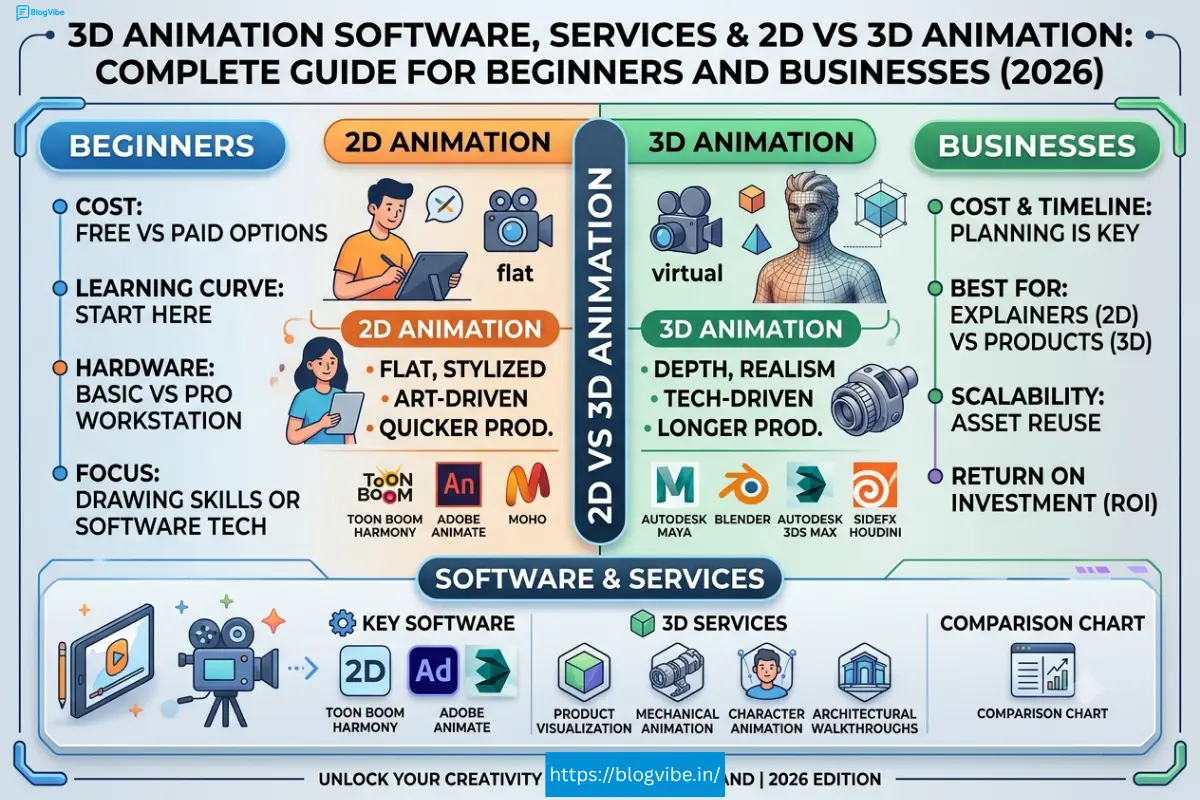
With the growth of advanced technology, 3D animation software has become more accessible, allowing beginners, designers, and professional studios to create realistic characters, environments, and visual effects. At the same time, companies are investing heavily in 3D animation services to improve their branding, advertising, education, and customer engagement.
One of the biggest questions businesses and creators face today is 2D vs 3D animation — which one is better? Both animation styles have unique advantages, and choosing the right option depends on your project goals, budget, audience, and creative requirements.
This complete guide explains everything about 3D animation software, professional animation services, and the key differences between 2D and 3D animation.
What Is 3D Animation?
3D animation is the process of creating moving images using three-dimensional digital objects. Unlike traditional 2D animation, which works with height and width, 3D animation adds depth, making objects appear more realistic.
In 3D animation, artists create digital models of characters, products, buildings, or environments. These models are then textured, rigged, animated, and rendered using specialized software.
For example:
- A car company can create a realistic 3D product animation showing every feature.
- A gaming studio can design realistic characters and worlds.
- A medical company can create 3D animations explaining complex procedures.
Today, 3D animation is widely used in:
- Movies and entertainment
- Video games
- Advertising
- Architecture
- Product visualization
- Education
- Healthcare
- Virtual reality (VR)
- Augmented reality (AR)
What Is 3D Animation Software?
3D animation software is a computer program that allows artists to create, edit, animate, and render three-dimensional graphics.
These tools provide features like:
- 3D modeling
- Character creation
- Motion design
- Lighting effects
- Simulation
- Rendering
- Visual effects
- Animation control
Professional animators use these software tools to transform ideas into realistic digital experiences.
Best 3D Animation Software in 2026
There are many 3D animation tools available today, ranging from beginner-friendly programs to advanced professional software.
1. Blender
Blender is one of the most popular free 3D animation software options available.
It is an open-source platform that provides complete animation features, including:
- 3D modeling
- Character animation
- Sculpting
- Video editing
- Visual effects
- Rendering
Advantages:
- Completely free
- Powerful features
- Large community support
- Suitable for beginners and professionals
Blender is widely used for creating short films, game assets, and product animations.
2. Autodesk Maya
Autodesk Maya is a professional-level 3D animation software used by major animation studios.
It is famous for:
- Character animation
- Advanced rigging
- Realistic effects
- Film-quality production
Many Hollywood studios and game developers use Maya for creating high-quality animations.
Advantages:
- Industry-standard software
- Powerful animation tools
- Excellent character creation features
3. Cinema 4D
Cinema 4D is popular among motion designers and advertising professionals.
It is known for:
- Easy workflow
- Fast rendering
- Motion graphics
- Product visualization
Businesses often use Cinema 4D for promotional videos, advertisements, and brand animations.
4. Autodesk 3ds Max
3ds Max is another popular professional 3D animation tool.
It is commonly used in:
- Architectural visualization
- Game development
- Product design
- Interior design
Its advanced modeling capabilities make it useful for creating detailed environments.
5. Adobe After Effects
Although mainly a motion graphics tool, After Effects is widely used with 3D animation workflows.
It helps creators add:
- Visual effects
- Motion graphics
- Text animation
- Cinematic effects
What Are 3D Animation Services?
3D animation services are professional solutions offered by animation studios and artists to create high-quality animated content for businesses and individuals.
Companies use these services when they need professional animations without building an internal animation team.
A professional 3D animation service usually includes:
1. 3D Product Animation
Product animation helps businesses showcase their products through realistic digital presentations.
Examples:
- Electronics demonstrations
- Automotive animations
- Machinery explanations
- Consumer product videos
Benefits:
- Shows product features clearly
- Improves customer understanding
- Helps increase sales
2. Character Animation Services
Character animation focuses on creating digital characters with realistic movements and expressions.
Used in:
- Movies
- Games
- Advertisements
- Educational videos
Professional animators create characters using modeling, rigging, and motion techniques.
3. Architectural 3D Animation
Architects and real estate companies use 3D animation to present buildings before construction.
It allows viewers to experience:
- Interior designs
- Exterior views
- Virtual walkthroughs
Benefits:
- Better client presentations
- Improved visualization
- Faster decision-making
4. 3D Explainer Videos
Businesses use 3D explainer animations to explain complex products or services.
Industries using explainer videos:
- Technology
- Healthcare
- Finance
- Manufacturing
These videos make complicated information easier to understand.
5. Game Animation Services
Game developers require professional 3D animation for:
- Characters
- Environments
- Weapons
- Creatures
- Special effects
High-quality animation improves player experience.
Benefits of Using 3D Animation for Businesses
Better Visual Communication
3D animation can explain ideas that are difficult to show through images or text.
For example, a machine manufacturer can demonstrate how internal parts work through animation.
Increased Customer Engagement
People are more likely to watch and remember animated content compared to traditional marketing materials.
3D visuals create stronger emotional connections.
Realistic Product Demonstration
Businesses can showcase products from every angle before customers purchase them.
This is especially useful for:
- Cars
- Electronics
- Furniture
- Industrial products
Cost-Effective Marketing
Although 3D animation requires initial investment, it can be reused across:
- Websites
- Social media
- Presentations
- Advertisements
This makes it valuable for long-term marketing.
2D vs 3D Animation: Complete Comparison
The debate between 2D vs 3D animation depends on the purpose of your project.
Both styles have different creative approaches.
What Is 2D Animation?
2D animation creates images using two dimensions:
- Height
- Width
It is based on traditional drawing techniques but is now mostly created digitally.
Examples:
- Cartoon shows
- Educational videos
- Explainer animations
- Simple advertisements
Popular 2D animation software includes:
- Adobe Animate
- Toon Boom Harmony
- OpenToonz
2D vs 3D Animation Differences
1. Visual Style
2D Animation:
- Flat appearance
- Artistic style
- Cartoon-like visuals
3D Animation:
- Realistic appearance
- Depth and dimension
- Cinematic quality
The winner depends on your creative goal.
2. Production Process
2D Animation Process:
- Drawing characters
- Creating frames
- Adding movement
- Editing scenes
3D Animation Process:
- Modeling objects
- Applying textures
- Rigging characters
- Lighting
- Rendering
3D animation usually requires more technical skills.
3. Cost
2D Animation:
Generally cheaper because it requires fewer resources.
3D Animation:
Usually more expensive due to:
- Advanced software
- Longer production time
- Skilled professionals
4. Realism
3D animation provides a higher level of realism.
It can simulate:
- Natural movements
- Real lighting
- Physical environments
2D animation focuses more on creativity and artistic expression.
5. Applications
2D Animation Uses:
- Cartoons
- Educational content
- Social media videos
- Simple advertisements
3D Animation Uses:
- Movies
- Games
- Product visualization
- Architecture
- VR experiences
Which Animation Style Should You Choose?
Choosing between 2D and 3D animation depends on your project requirements.
Choose 2D animation if:
- You have a limited budget
- You want a simple creative style
- You need quick production
Choose 3D animation if:
- You need realistic visuals
- You want premium branding
- You are creating products, games, or cinematic content
Future of 3D Animation
The future of 3D animation is growing rapidly because of artificial intelligence, virtual reality, and real-time rendering technology.
Future trends include:
AI-Powered Animation
AI tools are helping creators:
- Generate characters
- Automate movements
- Create realistic scenes faster
Real-Time Rendering
Modern engines allow creators to see animation results instantly instead of waiting hours for rendering.
Virtual Reality and Metaverse Experiences
3D animation plays an important role in creating immersive digital environments.
Industries like gaming, education, and shopping are adopting 3D experiences.
How to Choose the Right 3D Animation Service Provider?
Before hiring a 3D animation services company, consider:
Check Their Portfolio
Review previous projects to understand their quality and animation style.
Experience
Choose companies with experience in your industry.
Technology
Make sure they use modern animation software and techniques.
Budget
Compare pricing and ensure the service matches your requirements.
Communication
Good communication helps achieve better results.
Frequently Asked Questions (FAQs)
Is 3D animation better than 2D animation?
Neither is universally better. 3D animation is ideal for realistic visuals, while 2D animation works better for creative and simple designs.
Which software is best for 3D animation?
Blender is one of the best free options, while Autodesk Maya and Cinema 4D are popular professional choices.
How much does 3D animation cost?
The cost depends on project complexity, duration, quality level, and the animation studio you choose.
Can beginners learn 3D animation?
Yes. Beginners can start with free tools like Blender and learn through online tutorials and practice.
Conclusion
3D animation has become an essential technology for businesses, creators, and entertainment industries. With powerful 3D animation software, anyone can create impressive digital experiences, while professional 3D animation services help companies produce high-quality animations for marketing, education, and product presentations.
When comparing 2D vs 3D animation, the right choice depends on your goals, budget, and audience. 2D animation offers simplicity and creativity, while 3D animation provides realism and immersive experiences.
As technology continues to improve, 3D animation will become even more powerful, affordable, and accessible, making it one of the most valuable tools for digital storytelling in 2026 and beyond.