
Edge Computing vs Cloud Computing: Which Is Better?: Technology is evolving faster than ever, and businesses are processing more data than at any time in history. Whether you’re streaming videos, using AI tools, playing online games, or controlling smart devices, your data needs to be processed quickly and securely. This is where Edge Computing vs Cloud Computing come into play.
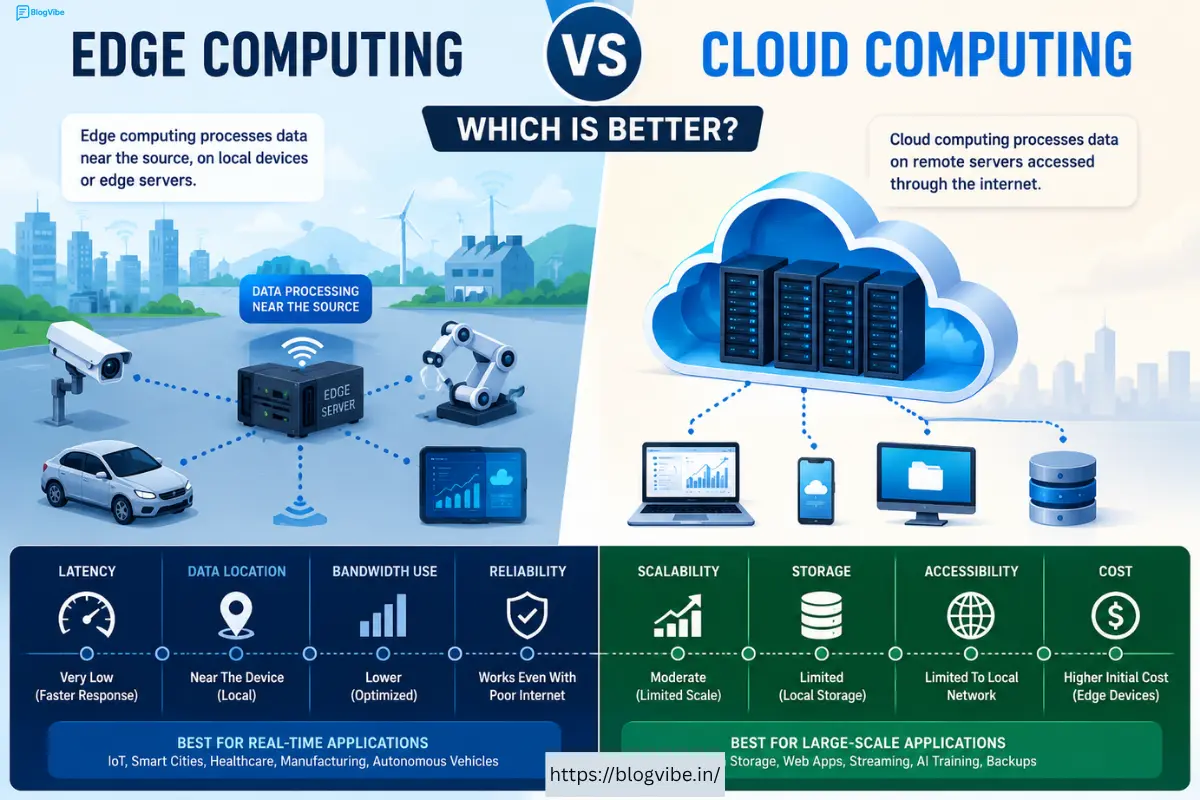
Although both technologies help store, manage, and process data, they work in different ways. Cloud computing sends data to remote data centers for processing, while edge computing processes data much closer to where it is created. Understanding the difference can help individuals and businesses choose the right solution.
In this beginner-friendly guide, you’ll learn what Edge Computing vs Cloud Computing are, how they work, their advantages and disadvantages, and which one is better in 2026.
What Is Cloud Computing?
Cloud computing is a technology that allows you to store files, run applications, and process data over the internet instead of relying on your own computer or local servers.
When you use services like online document editors, cloud storage, or streaming platforms, you’re already using cloud computing. Your data travels through the internet to powerful remote servers, where it is processed and stored before the results are sent back to your device.
How Cloud Computing Works
The process is simple:
- A user sends a request through the internet.
- The request reaches a remote cloud server.
- The server processes the information.
- The result is sent back to the user’s device.
Because these servers have massive computing power, cloud computing can handle millions of users simultaneously.
Common Examples of Cloud Computing
- Online file storage
- Video streaming services
- Email platforms
- AI chatbots
- Online gaming services
- Website hosting
- Business collaboration tools
Cloud computing has become the backbone of modern digital services because it is flexible, scalable, and cost-effective.
What Is Edge Computing?
Edge computing is a modern computing approach where data is processed close to the device that generates it instead of sending everything to a distant cloud server.
For example, imagine a self-driving car. It cannot wait several seconds for a cloud server to tell it when to brake. It must process sensor data instantly. Edge computing makes this possible by performing computations directly on the vehicle or a nearby edge server.
The main goal of edge computing is to reduce delays and improve real-time performance.
How Edge Computing Works
Instead of sending every piece of data to the cloud:
- Data is generated by a device.
- Nearby edge hardware processes the important information.
- Only necessary data is sent to the cloud for storage or further analysis.
This approach reduces internet traffic and speeds up response times.
Common Examples of Edge Computing
- Smart security cameras
- Self-driving cars
- Smart factories
- Wearable health devices
- Industrial robots
- Smart traffic systems
- IoT devices
- AI-powered surveillance systems
As AI and IoT continue to grow, edge computing is becoming increasingly important.
Edge Computing vs Cloud Computing: Key Difference
Although both technologies process data, the biggest difference is where that processing happens.
| Feature | Edge Computing | Cloud Computing |
| Data Processing | Near the device | Remote data centers |
| Speed | Very fast | Depends on internet |
| Latency | Very low | Higher |
| Internet Dependency | Low | High |
| Scalability | Moderate | Excellent |
| Real-Time Performance | Excellent | Good |
| Cost | Higher setup cost | Lower upfront cost |
| Storage Capacity | Limited | Massive |
For beginners, think of it like this:
- Cloud computing is like sending your homework to a teacher in another city and waiting for feedback.
- Edge computing is like asking the teacher sitting next to you. You get an answer almost instantly.
Why Edge Computing Is Growing in 2026
Artificial Intelligence, smart cities, autonomous vehicles, and connected devices generate enormous amounts of data every second. Sending all of that information to cloud servers can create delays and increase bandwidth costs.
Edge computing solves these challenges by processing data locally, making applications faster and more reliable. As a result, many industries are combining edge computing with cloud computing to achieve the best balance between speed and scalability.
In the next section, we’ll explore the major advantages and disadvantages of both technologies, compare their real-world use cases, and help you decide which one is the better choice for your needs.
Advantages and Disadvantages of Edge Computing
Edge computing has become one of the fastest-growing technologies because it allows data to be processed near the source instead of relying entirely on distant cloud servers. This makes it ideal for applications that require instant responses.
Advantages of Edge Computing
1. Ultra-Low Latency
Since data is processed close to the device, response times are extremely fast. This is essential for applications like autonomous vehicles, industrial robots, and smart healthcare devices.
2. Faster Performance
Devices can analyze and respond to information almost instantly without waiting for data to travel to a remote cloud server.
3. Reduced Bandwidth Usage
Only important data is sent to the cloud, which reduces internet traffic and lowers bandwidth costs.
4. Better Privacy
Sensitive information can remain on local devices instead of being continuously transmitted over the internet, reducing privacy risks.
5. Improved Reliability
Many edge devices can continue working even if the internet connection is slow or temporarily unavailable.
Disadvantages of Edge Computing
Higher Initial Cost
Organizations need to purchase edge servers, gateways, or specialized hardware, which increases upfront investment.
Limited Storage
Edge devices cannot store as much data as large cloud data centers.
Complex Management
Managing hundreds or thousands of edge devices across multiple locations can be challenging.
Hardware Maintenance
Edge infrastructure requires regular updates, maintenance, and monitoring.
Advantages and Disadvantages of Cloud Computing
Cloud computing remains one of the most widely used technologies because it offers flexibility, scalability, and cost efficiency.
Advantages of Cloud Computing
Massive Storage
Cloud providers offer virtually unlimited storage, making it suitable for businesses of all sizes.
Easy Scalability
Companies can increase or decrease computing resources whenever needed without purchasing new hardware.
Lower Upfront Costs
There is no need to build expensive server rooms. Most cloud services operate on a pay-as-you-go pricing model.
Automatic Updates
Cloud providers manage software updates, maintenance, backups, and security patches automatically.
Global Accessibility
Users can access applications and files from anywhere with an internet connection.
Disadvantages of Cloud Computing
Higher Latency
Because data travels to remote servers, there may be slight delays, especially for real-time applications.
Internet Dependency
Without a stable internet connection, cloud-based services may become slow or inaccessible.
Ongoing Subscription Costs
While startup costs are low, monthly subscription fees can become significant over time.
Privacy Concerns
Some businesses may hesitate to store highly sensitive information on third-party cloud servers.
Edge Computing vs Cloud Computing: Feature Comparison
| Feature | Edge Computing | Cloud Computing |
| Speed | ⭐⭐⭐⭐⭐ | ⭐⭐⭐ |
| Latency | Very Low | Medium |
| Storage | Limited | Unlimited |
| Cost | High Setup | Pay-as-you-go |
| Internet Requirement | Low | High |
| Security | Excellent for Local Data | Strong with Proper Configuration |
| Scalability | Moderate | Excellent |
| AI Processing | Excellent | Excellent |
| Real-Time Tasks | Best Choice | Good Choice |
| Backup & Recovery | Limited | Excellent |
Real-World Examples
Edge Computing Examples
- Self-driving cars process road conditions instantly.
- Smart traffic lights adjusting signals based on live traffic.
- Factory robots detecting faults in real time.
- Smart security cameras identifying suspicious activity locally.
- Wearable fitness devices monitoring heart rate without constant cloud communication.
Cloud Computing Examples
- Google Drive storing documents online.
- Microsoft OneDrive syncing files across devices.
- Netflix streaming movies worldwide.
- Spotify delivers music on demand.
- AI chatbots processing requests using powerful cloud servers.
- Website hosting platforms serving millions of visitors.
Edge Computing and Artificial Intelligence
Artificial Intelligence generates and processes enormous amounts of data. Running AI models directly on edge devices allows faster decision-making.
Examples include:
- AI-powered drones avoiding obstacles.
- Smart cameras recognize faces.
- Healthcare devices detecting abnormal heart rhythms.
- Manufacturing systems predicting equipment failures.
- Retail stores using AI for cashier-less shopping.
Combining AI with edge computing reduces delays and improves user experiences.
Which Industries Use Edge Computing?
Many industries are adopting edge computing to improve efficiency and reduce latency.
- Healthcare
- Manufacturing
- Smart Cities
- Agriculture
- Transportation
- Retail
- Telecommunications
- Energy
- Defense
- Logistics
These sectors rely on real-time data processing to make faster and more accurate decisions.
Cost Comparison
Edge Computing
Best for:
- Real-time systems
- Smart factories
- Autonomous vehicles
- IoT deployments
Costs include:
- Edge servers
- Hardware installation
- Device maintenance
- Local networking
Cloud Computing
Best for:
- Startups
- Websites
- Online businesses
- Content storage
- SaaS applications
Costs include:
- Monthly subscriptions
- Data transfer
- Storage usage
- Compute resources
For most beginners and small businesses, cloud computing offers a more affordable starting point. Edge computing becomes valuable when speed and low latency are critical.
FAQ (Edge Computing vs Cloud Computing)
1. What is the main difference between edge computing and cloud computing?
The main difference is where data is processed. Edge computing processes data close to the device that generates it, while cloud computing sends data to remote servers over the internet for processing. Edge computing offers lower latency, whereas cloud computing provides greater storage and scalability.
2. Which is better: Edge Computing vs Cloud Computing?
Neither is universally better. Edge computing is ideal for real-time applications such as self-driving cars, smart factories, and IoT devices because it minimizes latency. Cloud computing is better for data storage, large-scale applications, backups, and services that require high scalability. Many businesses use a combination of both.
3. Is edge computing faster than cloud computing?
Yes. Edge computing is generally faster because data is processed near the source instead of traveling to a distant cloud server. This reduces latency and enables real-time decision-making.
4. What are the advantages of cloud computing?
Cloud computing offers several benefits, including:
- Unlimited storage capacity
- Easy scalability
- Lower upfront costs
- Automatic software updates
- Access from anywhere with an internet connection
- Reliable backup and disaster recovery
5. What are the benefits of edge computing?
Edge computing provides:
- Low latency
- Faster data processing
- Reduced bandwidth usage
- Better privacy for sensitive data
- Improved performance for IoT and AI applications
- Greater reliability during network interruptions
6. Can edge computing replace cloud computing?
No. Edge computing is not designed to replace cloud computing. Instead, it complements the cloud by processing time-sensitive data locally while the cloud handles long-term storage, analytics, and large-scale computing.
7. Which is more secure: Edge Computing vs Cloud Computing?
Both can be secure when implemented correctly. Edge computing keeps sensitive data closer to the source, reducing exposure during transmission. Cloud computing providers offer advanced security features, encryption, and compliance tools, but security also depends on proper configuration and management.
8. What are some real-world examples of edge computing?
Common examples include:
- Self-driving cars
- Smart security cameras
- Industrial robots
- Smart traffic management systems
- Wearable health monitors
- AI-powered surveillance
- Smart manufacturing equipment
9. What are some examples of cloud computing?
Popular cloud computing examples include:
- Google Drive
- Microsoft OneDrive
- Dropbox
- Netflix
- Spotify
- Gmail
- Microsoft 365
- AI-powered online applications
10. How do AI and IoT use edge computing?
AI and IoT devices generate large amounts of data that often need instant processing. Edge computing allows AI models to analyze data locally, enabling faster decisions in applications such as autonomous vehicles, smart homes, healthcare devices, drones, and industrial automation.
11. Is cloud computing cheaper than edge computing?
For most individuals and small businesses, cloud computing is generally more cost-effective because it uses a pay-as-you-go pricing model and doesn’t require significant hardware investment. Edge computing often involves higher upfront costs due to specialized equipment and infrastructure.
12. What is the future of Edge Computing vs Cloud Computing?
The future lies in a hybrid approach, where edge computing handles real-time processing and cloud computing manages storage, analytics, and large-scale workloads. As AI, 5G, and IoT continue to expand, organizations will increasingly rely on both technologies to deliver faster, smarter, and more efficient digital services.
Conclusion(Edge Computing vs Cloud Computing)
Edge computing and cloud computing are both essential technologies, but they serve different purposes. Cloud computing is ideal for storing large amounts of data, running scalable applications, and enabling remote access, making it a great choice for businesses, websites, and everyday users. Edge computing, on the other hand, excels in situations where speed, low latency, and real-time decision-making are critical, such as autonomous vehicles, smart factories, healthcare devices, and IoT systems.
Rather than choosing one over the other, many organizations are adopting a hybrid approach that combines the strengths of both. Edge computing handles time-sensitive tasks locally, while cloud computing provides powerful storage, analytics, and long-term data management. This combination delivers better performance, improved security, and greater efficiency.
As technologies like Artificial Intelligence (AI), 5G, and the Internet of Things (IoT) continue to evolve, both edge computing and cloud computing will play an even bigger role in shaping the future of digital innovation. For beginners, understanding how these technologies work together is the key to making informed decisions, whether you’re building applications, starting a business, or simply exploring the world of modern computing.
In short: If your priority is real-time speed and low latency, edge computing is the better choice. If you need scalability, flexibility, and cost-effective storage, cloud computing is the winner. For most modern applications in 2026 and beyond, using both technologies together offers the best overall solution.