
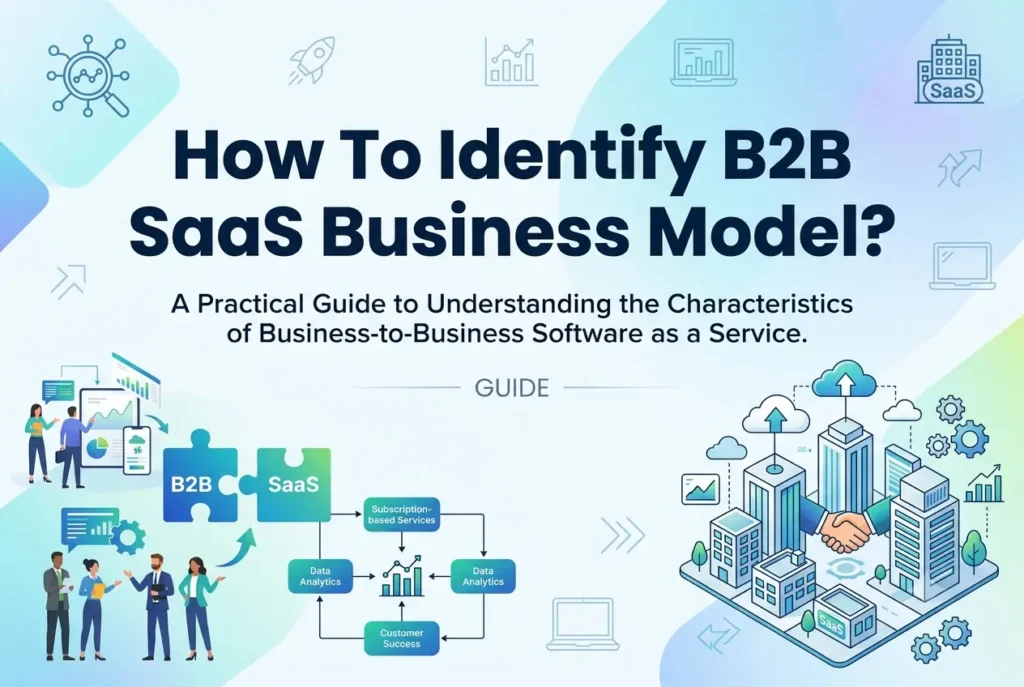
B2B SaaS has become one of the most popular business models in the modern software industry. From customer relationship management and accounting to marketing, HR, cybersecurity, and project management, businesses now rely on cloud-based software for everyday operations.
But how can you tell whether a company is actually using a B2B SaaS business model?
The answer is not simply whether a company sells software. A genuine B2B SaaS business typically combines business customers, cloud-based software, recurring subscriptions, online access, and continuous product updates.
In this guide, you’ll learn what B2B SaaS means, how the model works, the signs that identify a B2B SaaS company, its revenue and pricing models, examples, and how it differs from B2C SaaS.
What Is B2B SaaS?
B2B SaaS means Business-to-Business Software as a Service. It describes a business that provides software to other businesses through the internet, generally in exchange for recurring payments.
Instead of purchasing software permanently and installing it on individual computers, customers usually access a SaaS platform through a web browser or application.
For example, a company may pay a monthly or annual subscription to use software for:
- Customer relationship management
- Accounting
- Project management
- Human resources
- Marketing automation
- Cybersecurity
- Customer support
- Team communication
B2B SaaS Meaning
The term can be broken into two parts:
B2B (Business-to-Business): The customers are businesses or organizations rather than individual consumers.
SaaS (Software as a Service): The software is hosted and delivered online instead of being sold primarily as a one-time installed product.
Therefore, a simple definition is:
A B2B SaaS business sells cloud-based software to businesses through a subscription or other recurring payment model.
How Does the B2B SaaS Business Model Work?
The basic B2B SaaS business model is straightforward:
SaaS company → Business customer → Online software → Subscription → Recurring revenue
A SaaS company develops and maintains a software product. The product is hosted on cloud infrastructure, while customers access it through the internet.
Instead of paying once for permanent ownership, customers typically pay monthly or annually for continued access.
1. The Company Develops a SaaS Product
The business creates software designed to solve a specific problem.
For example, a SaaS product could help companies manage sales leads, employees, invoices, projects, or customer service.
2. Businesses Subscribe to the Software
Customers choose a subscription plan based on their requirements.
Plans may differ according to:
- Number of users
- Features
- Storage
- Usage
- Support level
- Business size
3. Customers Access the Software Online
The software is generally cloud-hosted, meaning customers don’t need to maintain their own software infrastructure.
4. The Company Generates Recurring Revenue
The company earns subscription revenue as customers continue using the product. This creates predictable revenue and gives the business an incentive to continuously improve customer retention.
10 Signs That a Company Uses a B2B SaaS Business Model
Identifying a B2B SaaS company becomes much easier when you know what signals to look for.
1. It Sells Software to Businesses
The first question is simple:
Who is the customer?
If the company primarily sells software to businesses, organizations, teams, or enterprises, that’s a strong B2B signal.
For example, software designed for sales teams, accountants, HR departments, or marketing agencies is generally B2B software.
2. The Software Is Cloud-Based
A typical SaaS product is hosted in the cloud.
Customers don’t usually need to install and maintain the entire software infrastructure themselves. They access the product through an internet connection.
This is one of the clearest SaaS characteristics.
3. Customers Pay a Recurring Subscription
Recurring payments are another major indicator. Instead of purchasing software once, customers may pay:
- Monthly
- Annually
- Per user
- Based on usage
This creates a recurring subscription relationship between the company and its customers.
4. It Offers Monthly or Annual Plans
Many SaaS companies provide different subscription options.
For example:
Starter: $20/month
Professional: $50/month
Business: $100/month
Some companies offer discounts when customers choose annual pricing instead of monthly pricing.
5. Customers Access the Product Online
A SaaS platform is generally available through a website or online application.
Users can log into their accounts from different devices without installing the entire software system locally.
6. Users Have Individual Accounts
B2B SaaS products commonly provide individual user accounts.
Businesses may create accounts for employees, administrators, managers, or other team members.
The company may charge based on the number of users or seats.
7. The Company Continuously Updates the Software
SaaS companies normally maintain their products continuously.
Updates can include:
- New features
- Security improvements
- Bug fixes
- Performance improvements
- User-interface changes
This continuous development is an important difference between modern SaaS and traditional software models.
8. It Offers Self-Service Signup or Free Trials
Many SaaS companies allow potential customers to:
- Create an account
- Start a free trial
- Request a demo
- Select a subscription plan
- Upgrade or downgrade their account
However, not every B2B SaaS company offers self-service signup. Enterprise SaaS businesses may rely heavily on sales teams and demonstrations.
9. Revenue Depends on Customer Retention
A SaaS company doesn’t just need to acquire customers; it needs to keep them.
If customers cancel their subscriptions, the company loses recurring revenue.
That’s why customer retention and churn rate are important SaaS business metrics.
10. It Generates Recurring Revenue
Finally, look at how the company makes money.
If a significant portion of revenue comes from continuing subscriptions, recurring payments, or usage-based contracts, that’s a strong indication of a SaaS business model.
How to Identify a SaaS Company: A Simple Checklist
If you’re analyzing an unfamiliar company, use this checklist:
Question | If the answer is “Yes” |
Does it sell software? | SaaS signal |
Is the software cloud-hosted? | Strong SaaS signal |
Can customers access it online? | SaaS signal |
Does it offer subscriptions? | Strong SaaS signal |
Does it charge monthly or annually? | SaaS signal |
Does it primarily serve businesses? | B2B signal |
Does it have multiple user accounts? | B2B SaaS signal |
Does it continuously update its product? | SaaS signal |
| Does it generate recurring revenue? | Strong SaaS signal |
The Simple B2B SaaS Formula
A useful way to remember it is:
Business customers + cloud software + recurring payments = strong B2B SaaS indication
The more of these characteristics a company has, the more likely it is operating a B2B SaaS business model.
What Are the Main B2B SaaS Revenue and Pricing Models?
Not every SaaS company makes money in exactly the same way.
SaaS Revenue Model
The SaaS revenue model describes how the company generates income from its software.
Common approaches include:
- Subscription fees
- Usage-based charges
- Per-user pricing
- Tiered pricing
- Freemium upgrades
- Enterprise contracts
SaaS Subscription Model
The subscription model is one of the most common approaches.
Customers pay repeatedly to maintain access to the software.
For example: $30 per user/month or $300 per user/year
The company benefits from recurring revenue while customers receive continuous access and updates.
SaaS Pricing Model
A SaaS pricing model determines how customers are charged.
Common pricing structures include:
Per-user pricing: Customers pay for each user.
Tiered pricing: Customers choose between different feature packages.
Usage-based pricing: Customers pay according to how much they use.
Freemium: Basic functionality is free, while advanced features require payment.
Enterprise pricing: Larger organizations receive customized plans and pricing.
B2B SaaS Business Model Examples
Looking at real-world categories makes the concept easier to understand.
CRM Software
A CRM platform helps businesses manage leads, customers, sales pipelines, and relationships.
Because the product is software delivered online to business customers, it can fit the B2B SaaS model.
Accounting Software
Cloud accounting platforms allow businesses to manage invoices, expenses, payroll, and financial records online.
They commonly use monthly or annual subscription plans.
Project Management Software
Project management platforms help teams organize tasks, deadlines, documents, and workflows.
Businesses typically pay according to users, features, or usage.
HR Software
HR SaaS products can help businesses manage employee information, recruitment, attendance, payroll, and benefits.
Marketing Automation Software
Businesses use marketing SaaS platforms to automate email campaigns, lead management, analytics, and customer journeys.
These examples demonstrate the central characteristics of B2B SaaS: business customers, cloud-based software, online access, and recurring revenue.
B2B SaaS vs. B2C SaaS: What’s the Difference?
Although both models use SaaS technology, their customers and sales processes can be very different.
Factor | B2B SaaS | B2C SaaS |
Customer | Businesses | Individual consumers |
Sales cycle | Often longer | Usually shorter |
Pricing | Often higher | Usually lower |
Decision makers | Multiple stakeholders | Usually one person |
Product requirements | Business-focused | Consumer-focused |
Customer acquisition | Sales + marketing | Often product/marketing-led |
Contracts | Can be annual or customized | Usually simple subscriptions |
For example, software designed for a company’s finance department is likely B2B SaaS, while a personal photo-editing subscription is more likely B2C SaaS.
What Are the Different Types of SaaS Business Models?
There are several ways SaaS companies structure their businesses.
- Subscription SaaS : Customers pay a recurring monthly or annual fee.
- Freemium SaaS : Users can access a basic version for free and pay for premium features.
- Usage-Based SaaS : Customers pay according to how much they use the product.
- Per-User SaaS : Pricing depends on the number of users or seats.
- Tiered SaaS : Different packages offer different features and pricing levels.
- Enterprise SaaS : The software is designed for larger organizations and may involve customized contracts, implementation, security requirements, and dedicated support.
A company can also combine several of these models.
<H2> Important B2B SaaS Business Metrics </H2>
If you want to analyze whether a company’s business model is truly SaaS-oriented, look at its key metrics.
Monthly Recurring Revenue (MRR): Measures predictable monthly subscription revenue.
Annual Recurring Revenue (ARR): Measures recurring revenue expected over a year.
Customer Acquisition Cost (CAC): Measures how much it costs to acquire a customer.
Customer lifetime value: Estimates the revenue a company can generate from a customer during the entire relationship.
Churn Rate: Measures the percentage of customers who stop using or paying for the service.
Customer Retention: Particularly important because SaaS companies depend on customers continuing their subscriptions.
Gross Margin : Software businesses can often achieve attractive gross margins because the same product can serve many customers without manufacturing a separate physical product for each one.
B2B SaaS Business Model vs. Traditional Software
Traditional software was often sold through a one-time license and installed locally.
B2B SaaS generally works differently.
Traditional Software | B2B SaaS |
Often one-time purchase | Usually recurring subscription |
Local installation | Cloud-based access |
Major version upgrades | Continuous updates |
Customer manages infrastructure | Provider manages hosting |
Limited recurring revenue | Recurring revenue |
However, the distinction isn’t always absolute. Some modern software businesses use hybrid licensing, cloud hosting, subscriptions, or usage-based pricing.
How to Tell If a Company Is B2B SaaS
When analyzing a company, follow these five steps.
Step 1: Identify the Customer
Determine whether the company primarily serves businesses or consumers.
Step 2: Identify What It Sells
Check whether its main product is software rather than consulting, hardware, or a physical product.
Step 3: Check How the Software Is Delivered
Look for cloud-based or online access.
Step 4: Examine How Customers Pay
Look for monthly subscriptions, annual subscriptions, usage-based pricing, or recurring contracts.
Step 5: Check for Recurring Revenue
Finally, determine whether customers continue paying to maintain access.
If all five characteristics are present, the company is very likely operating some form of B2B SaaS business model.
Frequently Asked Questions About B2B SaaS
Que: What Does B2B SaaS Mean?
B2B SaaS means Business-to-Business Software as a Service. It refers to software companies that provide cloud-based products to businesses, usually through recurring subscriptions.
Que: What Is An Example Of A B2B SaaS Company?
Examples include companies providing CRM, accounting, HR, project management, cybersecurity, marketing, and customer-support software to organizations.
Que: How Do I Identify A SaaS Company?
Look for cloud-based software, online access, recurring subscriptions, user accounts, continuous updates, and a software-based product.
Que: How Does A B2B SaaS Company Make Money?
Most B2B SaaS companies generate revenue through subscriptions, although some use usage-based, per-user, tiered, freemium, or enterprise pricing.
Que: What Is The Difference Between B2B And B2C SaaS?
B2B SaaS sells primarily to businesses, while B2C SaaS primarily serves individual consumers. B2B products often have higher prices, longer sales cycles, and multiple decision-makers.
Que: What Are The Main SaaS Revenue Models?
The main models include subscription, usage-based, per-user, tiered, freemium, and enterprise pricing.
Conclusion
Identifying a B2B SaaS business model becomes much easier when you focus on how the company delivers software, who its customers are, and how it generates revenue.
The strongest signals are business customers, cloud-based software, online access, recurring subscriptions, continuous updates, and recurring revenue.
You should also examine pricing, user accounts, free trials, customer retention, and SaaS metrics such as MRR, ARR, CAC, and churn.
Ultimately, don’t classify a company as B2B SaaS simply because it sells software. Look at the entire business model.
If a company provides software to businesses through the cloud and customers continuously pay for access, there’s a strong chance you’re looking at a B2B SaaS business model.
Follow blogvibe for latest trends and updates about the SaaS.