
AI Talking : Artificial Intelligence has evolved rapidly over the past few years, moving far beyond chatbots that simply answer questions. One of the most fascinating developments in 2026 is AI talking to each other. Instead of waiting for human instructions, intelligent systems can now exchange information, collaborate, negotiate tasks, and solve problems autonomously.
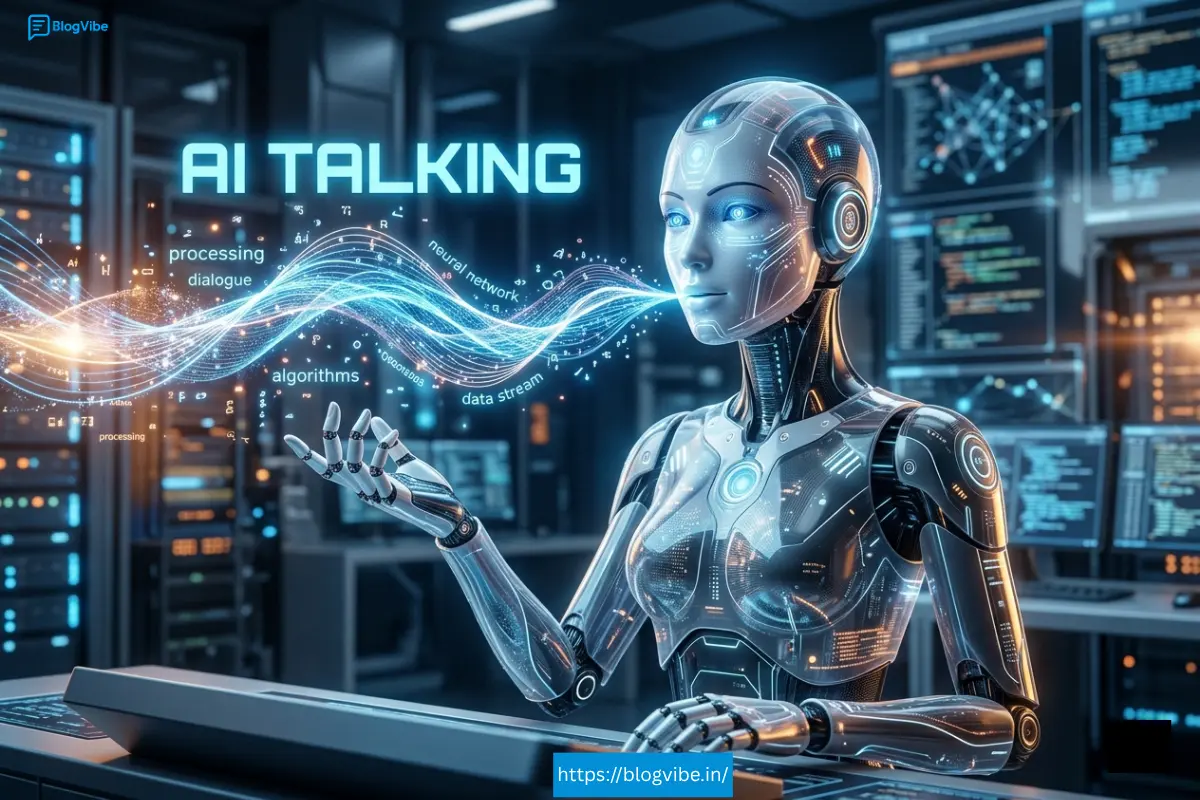
From customer service bots coordinating responses to autonomous vehicles sharing road conditions in real time, machine-to-machine communication is becoming one of the most transformative trends in technology.
But what exactly does it mean when AI systems talk to each other? How does it work? Is it safe? And what impact will it have on businesses, jobs, and society?
Let’s explore everything you need to know.
What Does AI Talking to Each Other Mean?
AI talking to each other refers to the process where two or more artificial intelligence systems communicate directly without requiring continuous human involvement.
This communication may involve:
- Sharing data
- Exchanging instructions
- Negotiating decisions
- Delegating tasks
- Learning from interactions
- Coordinating workflows
Unlike traditional software programs that follow predefined commands, modern AI agents can understand objectives, make decisions, and adapt their behavior based on new information.
Imagine having multiple digital employees working together:
One AI researches information.
Another summarizes findings.
A third writes reports.
A fourth schedules meetings.
Each system understands its role and communicates with the others automatically.
That is essentially AI-to-AI communication.
Why AI-to-AI Communication Matters in 2026
The world is producing more data than ever before.
Humans cannot process everything quickly enough.
Organizations need systems that can collaborate independently.
AI communication enables:
Faster decision-making
Machines exchange information instantly.
No emails.
No waiting.
No manual approvals.
Better productivity
Companies can automate entire workflows.
Tasks that once required ten employees may now be completed by interconnected AI systems.
Reduced operational costs
Businesses spend billions annually on repetitive administrative work.
AI agents can eliminate many of these expenses.
Improved customer experiences
Support bots can communicate with billing systems, inventory platforms, and recommendation engines simultaneously.
Customers receive faster responses.
Scalability
As businesses grow, AI systems can easily manage larger workloads without hiring additional teams.
How AI Systems Communicate
Several technologies enable AI communication.
1. APIs
Application Programming Interfaces allow AI systems to exchange information.
For example:
A chatbot requests weather data.
Another AI analyzes user preferences.
The response is returned instantly.
APIs act as translators between systems.
2. Shared Memory
Some AI models use centralized memory systems.
Information collected by one agent becomes available to others.
Example:
Agent A learns customer preferences.
Agent B accesses the same data.
Agent C generates personalized offers.
3. Message Queues
Large organizations use messaging systems.
Examples include:
- Kafka
- RabbitMQ
- Redis Streams
Messages are delivered efficiently between AI agents.
4. Agent Frameworks
Modern frameworks make multi-agent communication easier.
Popular solutions include:
- AutoGen
- CrewAI
- LangGraph
- OpenAI Agents SDK
- Semantic Kernel
These tools allow developers to build teams of AI assistants.
Real Examples of AI Talking to Each Other
AI communication is already happening around us.
Autonomous Vehicles
Self-driving cars continuously exchange information.
They share:
Traffic conditions
Road hazards
Speed updates
Navigation routes
This coordination improves safety.
Smart Homes
Voice assistants interact with various devices.
Examples:
Lights communicate with motion sensors.
Security systems notify cameras.
Thermostats learn occupancy patterns.
Everything works together.
Healthcare
Hospitals increasingly use AI tools.
Diagnostic systems share findings with scheduling software.
Medical assistants coordinate patient records.
Prescription systems verify drug interactions.
Doctors save valuable time.
Financial Institutions
Banks deploy multiple AI systems.
Fraud detection engines identify suspicious transactions.
Risk assessment models evaluate customers.
Chatbots provide account support.
These systems exchange information instantly.
E-commerce
Online retailers rely heavily on AI collaboration.
Inventory AI tracks stock.
Pricing AI adjusts discounts.
Recommendation engines suggest products.
Marketing tools create personalized campaigns.
Customers receive highly targeted experiences.
Multi-Agent AI Systems Explained
One of the hottest trends in 2026 is multi-agent AI.
Instead of building one giant AI model, developers create specialized agents.
Each performs a unique task.
Research Agent
Find information.
Planning Agent
Creates strategies.
Coding Agent
Builds applications.
Testing Agent
Detects errors.
Writing Agent
Produces content.
Reviewer Agent
Check quality.
Together, these agents function similarly to human teams.
The difference is speed.
Machines can complete hours of work within minutes.
Can AI Create Their Own Language?
Yes.
Researchers have discovered situations where AI systems develop communication shortcuts.
Rather than using human language, they invent efficient patterns.
This phenomenon has been observed in negotiation experiments.
The purpose is optimization.
AI seeks the fastest method to exchange information.
However, developers typically restrict such behavior.
Human-readable communication remains important.
Transparency matters.
Businesses need to understand why decisions are made.
Is AI Talking to Each Other Dangerous?
The topic generates considerable debate.
Several concerns exist.
Lack of Transparency
Complex AI conversations may become difficult to monitor.
Organizations may struggle to understand outcomes.
Security Risks
Hackers might intercept communications.
Sensitive information could be exposed.
Encryption becomes essential.
Bias Amplification
One biased AI may influence others.
Errors can spread rapidly.
Continuous monitoring is necessary.
Autonomous Decisions
Excessive automation raises ethical questions.
Should machines make important decisions independently?
Many experts believe humans should remain involved in critical situations.
Benefits of AI Communicating with AI
Despite challenges, benefits outweigh concerns.
Increased Efficiency
Tasks finish significantly faster.
24/7 Availability
AI agents never sleep.
Operations continue continuously.
Better Accuracy
Machines reduce human mistakes.
Cost Savings
Companies lower staffing expenses.
Personalized Services
Customers enjoy customized recommendations.
Faster Innovation
Researchers can accelerate discoveries.
Scientific breakthroughs may happen more quickly.
Industries Being Transformed
Manufacturing
Factories coordinate robots automatically.
Machines schedule maintenance.
Production becomes smarter.
Logistics
Delivery companies optimize routes.
Warehouses communicate inventory updates.
Packages arrive faster.
Education
AI tutors collaborate.
Students receive personalized lessons.
Assignments adapt to learning styles.
Cybersecurity
Security agents identify threats.
Other systems deploy defenses immediately.
Response times improve dramatically.
Entertainment
Gaming companies create intelligent NPCs.
Virtual characters communicate naturally.
Immersive experiences become possible.
AI Agents and the Future Workplace
Many professionals wonder whether AI collaboration will replace jobs.
The answer is more nuanced.
Certain repetitive tasks will disappear.
However, entirely new opportunities are emerging.
Future roles may include:
AI workflow designer
Prompt engineer
AI supervisor
Automation strategist
Machine collaboration specialist
Human oversight remains valuable.
Creativity, empathy, leadership, and strategic thinking are difficult to automate.
People who learn to work alongside AI systems will likely benefit the most.
The Rise of Autonomous AI Businesses
Some startups are experimenting with AI-operated companies.
Imagine a business where:
An AI CEO sets goals.
A marketing AI creates campaigns.
Sales AI manages leads.
Accounting AI tracks finances.
Customer support AI answers inquiries.
Humans monitor overall strategy.
While fully autonomous companies are still uncommon, the concept is gaining momentum.
Experts believe hybrid organizations may become widespread during the next decade.
How Businesses Can Prepare
Organizations should start exploring AI collaboration today.
Invest in AI literacy
Employees need foundational knowledge.
Test small projects
Begin with simple automations.
Measure results.
Maintain human oversight
Critical decisions require review.
Focus on security
Protect communications.
Implement strong access controls.
Choose scalable platforms
Select tools that support multiple AI agents.
Flexibility matters.
The Future of AI Talking to Each Other
The next phase of artificial intelligence will likely involve networks of specialized agents working together seamlessly.
Instead of interacting with a single chatbot, users may soon have access to entire teams of AI assistants handling research, scheduling, content creation, coding, customer support, and decision-making simultaneously.
AI talking to each other is not science fiction anymore.
It is already reshaping industries, improving productivity, and redefining how organizations operate.
The biggest question is no longer whether AI systems can communicate.
The real question is how humans will guide, regulate, and collaborate with these increasingly intelligent digital partners.
Businesses that embrace this transformation early may gain significant advantages in efficiency, innovation, and competitiveness.
As 2026 unfolds, AI-to-AI communication could become one of the most important technological shifts of the decade.
FAQs
Can AI really talk to other AI systems?
Yes. Modern AI agents can exchange information, coordinate tasks, and collaborate using APIs, messaging systems, and shared memory.
Is AI-to-AI communication already being used?
Absolutely. Autonomous vehicles, healthcare platforms, banks, smart homes, and e-commerce companies already use interconnected AI systems.
Will AI talking to each other replace human workers?
Some repetitive jobs may be automated, but new roles focused on AI management, oversight, and strategy are expected to grow.
Can AI invent its own language?
Researchers have observed AI systems creating communication shortcuts in certain experiments, but developers usually ensure interactions remain understandable to humans.
Is AI-to-AI communication safe?
It can be safe when organizations implement security measures, maintain transparency, and keep humans involved in critical decisions.
READ MORE: