
Ai Blogs : To identify the best tech and AI blogs in 2026, we evaluated 58 websites using seven measurable performance factors. This ranking is entirely data-based — no paid placements, no personal bias, and no inactive corporate blogs included.
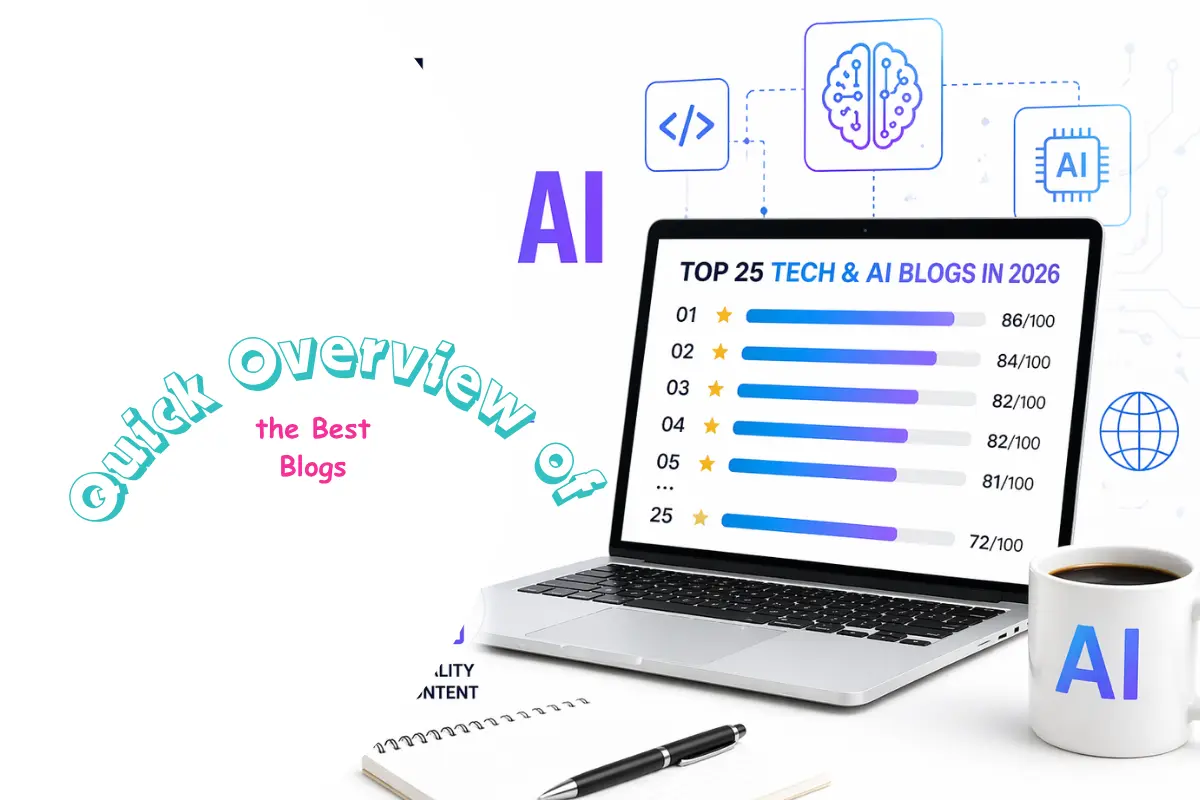
Out of all the blogs analyzed, 48 met the minimum benchmark score of 40 and were eligible for inclusion.
Quick Overview of the Best Blogs
The highest-performing blogs this year include:
- Sebastian Raschka (86)
- Machine Learning Mastery (84)
- Josh Comeau (82)
- Simon Willison (82)
- Troy Hunt (81)
- The Defiant (80)
- Robin Wieruch (80)
- Krebs on Security (80)
- The New Stack (79)
- Michael Lynch (78)
(and others completing the top 25)
How the Scores Are Calculated
Each blog receives an overall score out of 100, based on:
- Authority of the domain
- Frequency of new content
- Website loading speed
- Mobile usability
- Total content published
- Security (SSL)
- Credibility and trust indicators
These scores are updated regularly to reflect current performance.
Key Observations
Content consistency matters more than authority
Blogs that publish regularly and maintain a large archive tend to outperform those with higher domain authority but less activity.
Speed has a strong impact
Fast-loading websites consistently rank higher. Even small performance gaps can significantly affect positions.
Fresh content is essential
Most top blogs publish at least once a week. Less frequent updates can lead to lower scores.
Authority alone isn’t enough
Even well-known blogs can rank lower if they fall behind in speed, updates, or engagement.
Highlights from the Top 10
Sebastian Raschka (86)
Known for simplifying complex AI topics, especially large language models, through practical explanations and hands-on guides.
Machine Learning Mastery (84)
Offers a massive collection of structured tutorials, making machine learning accessible from beginner to advanced levels.
Josh Comeau (82)
Creates interactive learning experiences that help developers understand frontend concepts like CSS and React.
Simon Willison (82)
Shares frequent updates on AI tools and open-source projects, with an extensive archive built over many years.
Troy Hunt (81)
Focuses on cybersecurity, offering insights into data breaches and online safety practices.
The Defiant (80)
Provides in-depth coverage of decentralized finance and crypto with a journalistic approach.
Robin Wieruch (80)
Publishes practical coding tutorials focused on real-world development using modern technologies.
Krebs on Security (80)
Specializes in investigative reporting on cybercrime and digital threats.
The New Stack (79)
Covers cloud infrastructure, DevOps, and modern software architecture.
Michael Lynch (78)
Shares transparent experiences of building and scaling independent tech products.
Best Blogs by Category
AI & Machine Learning
These blogs focus on research, tutorials, and real-world AI applications:
Sebastian Raschka, Machine Learning Mastery, Vicki Boykis, Andrej Karpathy, Lilian Weng
Cybersecurity
Focused on threats, breaches, and defense strategies:
Troy Hunt, Krebs on Security, Daniel Miessler, Graham Cluley
Web Development
Cover frontend and backend technologies:
Josh Comeau, Robin Wieruch, Lea Verou, Chris Coyier, Ahmad Shadeed, Kent C. Dodds
Engineering Leadership
Insights into managing teams and scaling systems:
Will Larson, Michael Lynch, Coding Horror
Systems & Infrastructure
Deep technical content on low-level computing:
Julia Evans, Xe Iaso, Salvatore Sanfilippo, Dan Luu, Bartosz Ciechanowski
Overall Trends
- Average score across all qualified blogs: 67
- Average score among top 25: 77
- Rankings are closely grouped at the top
- Individual bloggers dominate the list (23 out of 25)
- Independent creators often outperform large media sites in speed and consistency
Conclusion
Tech blogs continue to play a crucial role even in the age of AI tools and video content. They provide detailed explanations, practical examples, and reliable insights that are difficult to replace.
Frequently Asked Questions
What is the finest tech blog for 2026?
According to our numbers, Sebastian Raschka is in first place with an Awesome Score of 86 out of 100. Machine Learning Mastery is in second place with 84, while Josh Comeau and Simon Willison are tied for third place with 82. Sebastian Raschka is the greatest site for LLM research, Machine Learning Mastery has structured ML training for all levels, and Simon Willison is the best place to stay up to date on AI technologies and open-source projects.a
How do you rate blogs on tech and AI?
The Awesome Score technique looks at seven different metrics: domain authority (25 points), content freshness (20 points), site speed (10 points), mobile readiness (10 points), content volume (15 points), SSL security (5 points), and trust signals (15 points). Scores are automatically figured out and updated every week. No blog can pay to get a better ranking. You may read the whole method here.
Why do personal blogs get more traffic than big newspapers?
No matter how big or small the team is, our scoring system looks at the same seven parameters for every blog. Developers’ personal blogs usually have faster sites, better mobile performance, and more regular writing schedules than big sites that are weighed down by ad tech, third-party scripts, and complicated CMS settings. The data shows this – 23 of the top 25 tech blogs are run by people.
How high should the Awesome Score be for a tech blog?
The average score for all 48 tech blogs in our directory that met the requirements is about 67 out of 100. A blog is in the top 25 if it gets a score of 73 or higher, and in the top 10 if it gets a score of 78 or higher. The tech blog with the most points gets 86. To be listed in the directory, a site must have a score of at least 40. This keeps away sites that are inactive, abandoned, or not well-maintained.
Are tech blogs still useful now that there are AI helpers and videos?
Of course. AI assistants often use blog postings as sources, and the blogs on this list are some of the most popular in their professions. Long-form textual content has more detail, code examples, and subtle explanations than video lessons and chat sessions can offer. Simon Willison’s posts about AI tools, Julia Evans’ posts about systems, and Sebastian Raschka’s LLM tutorials all show that written blogs are still the best way to share technical information. The best blogs in our database are getting bigger, not smaller.
How do I get my tech blog on a list?
Send in your blog for a free, automated review. It only takes a few minutes to score, and you’ll get a summary of all seven criteria. Your blog will obtain a permanent do-follow backlink in the Tech & AI directory if it gets a score of 40 or higher. If you want to raise your score first, look at our tutorial on how to raise your domain authority and the free blogger toolbox.
What tech blogs have the fastest loading times?
Sebastian Raschka, Machine Learning Mastery, Josh Comeau, Troy Hunt, Robin Wieruch, Julia Evans, Cassidy Williams, Nolan Lawson, Maggie Appleton, and Vicki Boykis are some of the blogs in our top 25 that get flawless 10/10 speed scores. Josh Comeau’s flawless speed score is especially impressive because every post has a lot of interactive aspects. The New Stack (4/10), Daniel Miessler (4/10), and Lea Verou (4/10) all have blogs that don’t load quickly. They could all get 5–6 points only by making their pages load faster