
Businesses have used automation for years to save time, reduce repetitive work, and improve productivity. Traditional automation helps companies complete routine tasks by following predefined rules and workflows. However, advances in artificial intelligence are introducing a more flexible way to automate business operations.
This is where agentic AI comes in.
So, how does agentic AI differ from traditional automation?
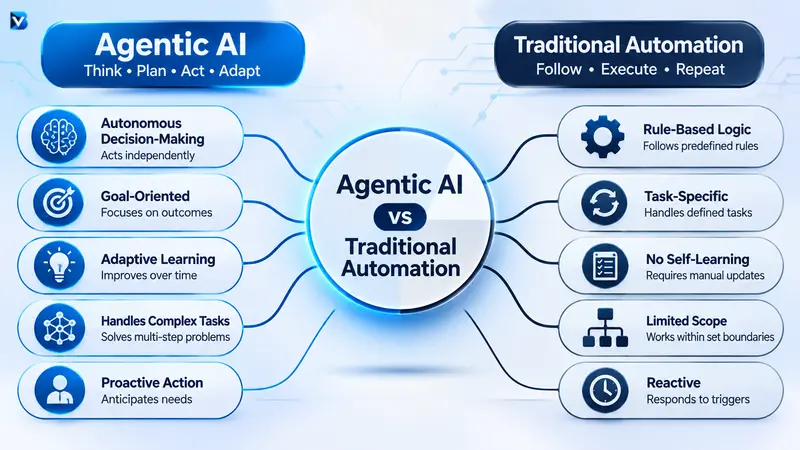
The biggest difference is how these technologies handle tasks and decisions. Traditional automation follows instructions configured in advance, while agentic AI can understand a goal, plan actions, use connected tools, and adjust its approach based on the results.
For example, traditional automation can send an automatic email when a customer places an order. An agentic AI system could investigate a customer’s unusual order problem, retrieve relevant information, and recommend an appropriate solution.
Both technologies offer valuable benefits, but they are not designed for exactly the same tasks.
In this guide, we will explore 7 key differences between agentic AI and traditional automation, including their working methods, decision-making abilities, costs, security, and real-world business applications.
What Is Traditional Automation?
Traditional automation is a technology that performs repetitive tasks using predefined instructions, rules, and workflows.
It allows businesses to complete routine activities without requiring employees to perform every step manually.
For example, a business can use traditional automation to:
- Send welcome emails when someone subscribes to a newsletter.
- Generate invoices after successful payments.
- Update inventory when customers place orders.
- Send automatic appointment reminders.
- Transfer information between connected applications.
- Notify employees when a new task is assigned.
These activities happen according to conditions and instructions configured by the user.
How Does Traditional Automation Work?
Traditional automation generally follows a structured process:
- Trigger: An event starts the workflow.
- Condition: The system checks predefined rules.
- Action: It performs the configured task.
- Completion: The workflow finishes.
For example, imagine someone purchases a product from an online store.
The automation system detects the successful payment, generates an order confirmation, updates the inventory, and sends an email to the customer.
The system does not need to understand why the customer purchased the product. It simply follows the configured workflow.
Traditional automation is particularly useful for predictable business processes that require the same actions repeatedly.
What Is Agentic AI?
Agentic AI refers to AI systems that can work toward a specific goal by understanding information, planning actions, using tools, and evaluating results.
Unlike traditional automation, agentic AI is not limited to executing one fixed sequence of instructions. It can select appropriate next steps based on the information available and the goal it needs to achieve.
For example, consider a company that receives hundreds of customer support emails.
An agentic AI system could:
- Read incoming customer messages.
- Understand the customer’s main problem.
- Retrieve relevant information from approved sources.
- Check company policies.
- Prepare a personalized response.
- Escalate complicated requests to a human employee.
These activities can be coordinated by the AI system to help resolve customer problems.
However, agentic AI is not completely independent or always accurate. Its performance depends on the AI model, instructions, available tools, data quality, and permissions.
How Does Agentic AI Work?
An agentic AI system generally uses five important capabilities:
- Understanding: It interprets the user’s request and available information.
- Planning: It identifies the steps required to achieve the goal.
- Tool usage: It accesses approved applications, APIs, and databases.
- Execution: It performs actions within its assigned permissions.
- Evaluation: It checks the results and decides what to do next.
This process can repeat until the task is completed, human approval is required, or the system reaches a limitation.
For example, an AI agent researching a customer complaint may first retrieve an order number, check delivery information, review the refund policy, and then prepare a recommendation.
This goal-oriented approach makes agentic AI useful for more dynamic business processes.
How Does Agentic AI Differ From Traditional Automation? 7 Key Differences
Agentic AI and traditional automation can both reduce manual work, but they differ in how they process information, make decisions, and complete tasks.
Here are seven important differences businesses should understand.
1. Decision-Making and Reasoning
Decision-making is one of the biggest differences between agentic AI and traditional automation.
Traditional automation follows predefined conditions established by a person.
For example:
If an invoice amount exceeds $1,000, send it to a manager for approval.
The system checks the invoice amount and performs the configured action.
Agentic AI can consider additional information before recommending an action.
For example, it could examine an invoice, compare it with a purchase order, identify unusual charges, and prepare a report explaining the discrepancy.
A human employee can then review the findings before approving payment.
Key difference: Traditional automation follows predefined rules, while agentic AI can make contextual decisions within its assigned permissions.
2. Flexibility and Adaptability
Traditional automation works best when business processes remain consistent.
If a company changes its order-processing procedure, the existing workflow may need to be updated manually.
Agentic AI offers greater flexibility when handling changing information and unexpected situations.
For example, a customer might ask a support question that is not covered by a standard response template.
An agentic AI system could interpret the question, search approved product documentation, and prepare a relevant answer using the available information.
However, its response still needs to be checked when accuracy is important.
Key difference: Traditional automation depends on predefined workflows, while agentic AI can adjust its approach based on changing information.
3. Human Involvement and Supervision
Both technologies can perform tasks without someone manually completing every step. However, human involvement works differently.
Traditional automation requires people to configure triggers, rules, conditions, and actions. Humans generally become involved when a workflow needs updating or encounters an exception.
Agentic AI can handle more contextual tasks, but businesses should decide which activities require human approval.
For example, an AI agent might review a refund request, check the company’s return policy, and recommend whether the customer qualifies.
However, a human employee may still need to approve the actual refund.
This is especially important when activities involve financial transactions, personal information, or important business decisions.
Key difference: Traditional automation relies on human-defined workflows, while agentic AI can handle contextual tasks with human supervision based on risk.
4. Handling Complex Tasks
Traditional automation is suitable for processes that can be divided into clear, repeatable steps.
However, some business activities require several decisions and interactions across different applications.
Consider a customer who reports a problem with an online order.
Resolving the request may require checking:
- Customer account information.
- Previous orders.
- Payment status.
- Shipping details.
- Return and refund policies.
A traditional automation workflow can handle these operations through predefined conditions and integrations.
An agentic AI system can interpret the complaint, identify the information it needs, use approved tools to retrieve relevant records, and prepare a suitable resolution.
It can also determine when additional information or human assistance is required.
Key difference: Traditional automation executes configured steps, while agentic AI can coordinate multiple actions toward a larger goal.
5. Learning, Feedback, and Improvement
Traditional automation does not automatically change its rules based on completed tasks.
When business requirements change, someone usually needs to update the workflow.
Agentic AI systems can evaluate previous actions and use configured feedback mechanisms to adjust future decisions.
For example, an AI support agent might discover that a particular customer request requires additional information before it can prepare a useful response.
It can adjust its next steps accordingly.
However, there is an important distinction: an AI agent evaluating previous results does not mean its underlying AI model automatically retrains itself.
Improvements may require updated instructions, memory systems, feedback mechanisms, evaluation processes, or model updates.
Key difference: Traditional automation generally requires explicit workflow changes, whereas agentic AI can use feedback and evaluation mechanisms to adjust its actions.
6. Implementation Costs and Maintenance
The cost of traditional automation and agentic AI depends on how each technology is implemented.
Traditional automation generally involves workflow development, software subscriptions, integrations, and maintenance.
Once a stable workflow is configured, its execution costs can be relatively predictable.
Agentic AI may introduce additional expenses, including:
- AI model and API usage.
- Multiple AI interactions.
- External tool integrations.
- Data processing and infrastructure.
- Security and monitoring.
- Testing and ongoing maintenance.
For example, sending an automatic payment confirmation may require only one predefined action.
An agentic AI system investigating a complicated customer request may require multiple AI interactions and external tool calls.
This can increase operating costs.
However, the overall financial value depends on task complexity, business volume, implementation costs, and the time saved.
Key difference: Traditional automation can be more economical for stable repetitive processes, while agentic AI may justify additional costs when complex decision-making creates sufficient business value.
7. Security, Control, and Reliability
Traditional automation generally executes predefined actions, making its behaviour easier to predict and test.
Agentic AI introduces additional security considerations because it can interpret information, select actions, and interact with connected applications.
Potential risks include:
- Incorrect decisions or recommendations.
- Unauthorized access to business information.
- Unexpected actions.
- Exposure of sensitive customer data.
- Prompt injection attacks.
- Difficulty investigating certain decisions.
Businesses should establish appropriate permissions and security controls before deploying agentic AI.
Important safeguards include:
- Restricting access to necessary tools and data.
- Maintaining activity logs.
- Monitoring important actions.
- Requiring human approval for sensitive operations.
- Testing for unexpected behaviour.
- Creating recovery and escalation procedures.
For example, an AI agent may be allowed to prepare payment instructions, but it should not transfer money without the required authorization.
Key difference: Traditional automation usually follows predictable rules, while agentic AI offers greater flexibility but requires additional controls around its decisions and actions.
Agentic AI vs Traditional Automation: Comparison Table
The following comparison highlights the main differences between these two technologies.
| Feature | Traditional Automation | Agentic AI |
| Working method | Predefined rules | Goal-oriented reasoning |
| Decision-making | Rule-based | Context-dependent |
| Flexibility | Usually limited | More adaptable |
| Execution | Configured steps | Dynamically selected steps |
| Complex tasks | Requires explicit workflows | Can coordinate multiple actions |
| Data handling | Often structured inputs | Structured and unstructured information |
| Human involvement | Configuration and exception handling | Supervision and approval based on risk |
| Feedback | Explicit workflow updates | Configured evaluation mechanisms |
| Maintenance | Rules and integrations | Models, tools, permissions, and workflows |
| Cost | Often predictable | Depends on model and tool usage |
| Best use | Repetitive business processes | Dynamic, decision-intensive tasks |
Neither technology is the best choice for every situation.
Traditional automation is often a better option for simple, predictable processes, while agentic AI is more useful when tasks require contextual understanding and flexible decision-making.
Real-World Examples of Agentic AI in Business
Agentic AI can support different business operations by combining AI reasoning, information retrieval, and external tools.
Here are four practical applications.
1. Customer Support Automation
Traditional automation can send an automatic confirmation email when a customer submits a support request.
Agentic AI can go further by understanding the customer’s problem, retrieving relevant account information, checking approved company documentation, and preparing a personalized response.
For complicated requests, the system can escalate the conversation to a human support representative.
2. AI-Powered Lead Generation
Traditional automation can collect contact information, add leads to a CRM, and send predefined follow-up emails.
Agentic AI can research potential customers using approved sources, organize business information, identify relevant prospects, and prepare personalized outreach drafts.
A salesperson can review the information before approving external communication.
This approach can help sales teams reduce manual research and organize their lead-generation activities.
3. Invoice Processing and Financial Operations
Traditional automation can extract invoice details and send documents through an approval workflow.
An agentic AI system can compare invoice information with purchase orders, identify unusual entries, investigate discrepancies through approved records, and recommend the next action.
Human approval should remain in place for important financial transactions.
4. AI Marketing Automation
Traditional automation can schedule social media posts, send email campaigns, and publish content at predefined times.
Agentic AI can analyze campaign information, identify underperforming content, suggest improvements, and prepare alternative marketing messages.
Marketing employees can review these suggestions before publishing content or changing advertising budgets.
These examples demonstrate potential applications. Actual results depend on implementation quality, data, and business requirements.
Advantages and Disadvantages of Agentic AI
Before adopting agentic AI, businesses should understand its benefits as well as its limitations.
Advantages of Agentic AI
1. Greater flexibility: It can respond to changing information and situations instead of depending entirely on fixed workflows.
2. Complex task management: It can coordinate multiple activities to achieve a specific objective.
3. Contextual understanding: It can interpret information from emails, documents, and other business sources.
4. External tool integration: It can interact with approved APIs, databases, and business applications.
5. Workflow coordination: It can reduce manual coordination between different business activities.
Disadvantages of Agentic AI
1. Implementation complexity: Building a reliable system requires suitable architecture, integrations, and testing.
2. Variable operating costs: AI model usage and external tool calls can increase expenses.
3. Incorrect outputs: AI systems can misunderstand requests or generate inaccurate information.
4. Security concerns: Connecting agents to business applications creates additional risks.
5. Monitoring requirements: Businesses need to review performance, permissions, and unexpected actions.
Agentic AI can create significant value, but it should not replace a simple and reliable automation workflow without a clear business reason.
Can Agentic AI Replace Traditional Automation?
Agentic AI can replace some traditional automation use cases, particularly tasks involving complex decisions, changing conditions, and unstructured information.
However, traditional automation remains useful for many everyday business processes.
For example, an online store can continue using traditional automation for:
- Generating order confirmations.
- Updating inventory.
- Sending payment notifications.
- Calculating fixed shipping charges.
- Scheduling email reminders.
Agentic AI may be more useful for:
- Investigating unusual orders.
- Understanding complicated customer requests.
- Coordinating exceptions across different applications.
- Preparing recommendations for employees.
- Researching business information.
For many organizations, a hybrid automation strategy makes more sense than replacing every workflow with AI.
In this approach, agentic AI handles tasks requiring interpretation and contextual decisions, while traditional automation executes predictable operations.
This combination can provide flexibility without sacrificing control over important business activities.
How to Implement Agentic AI in a Business
Businesses do not need to introduce agentic AI into every department at once.
A gradual implementation approach can help reduce costs, improve reliability, and avoid unnecessary risks.
Step 1: Identify the Right Business Task
Start by identifying a business process that involves repetitive work and some decision-making.
For example, classifying incoming customer support emails could be a suitable starting point.
Choose a task where AI can provide measurable value without creating significant risks.
Step 2: Define a Clear Goal
Explain exactly what the AI system should accomplish.
For example:
“Review incoming customer requests, identify their main problems, and prepare suitable responses using approved company documentation.”
A clearly defined objective helps the system stay focused and makes its performance easier to evaluate.
Step 3: Choose the Required AI Tools
Select the AI model, data sources, APIs, and software integrations needed for the task.
Depending on the application, a business might need access to a CRM, customer support platform, internal knowledge base, or database.
Avoid providing unnecessary access to business applications or sensitive information.
Step 4: Set Permissions and Security Controls
Decide which activities the AI agent can perform independently and which require human approval.
For example:
- It can read customer support messages.
- It can search approved documentation.
- It can prepare response drafts.
- It cannot delete customer accounts.
- It cannot issue refunds without approval.
Clear permissions help reduce the risks associated with autonomous actions.
Step 5: Test the AI Agent
Before using the system in daily operations, test it with different situations.
Check how it handles:
- Missing information.
- Unexpected requests.
- Inaccurate data.
- Tool connection failures.
- Conflicting instructions.
- Sensitive customer information.
Testing helps identify problems before they affect actual business operations.
Step 6: Monitor and Improve Performance
Track important performance indicators, including:
- Task completion rate.
- Response accuracy.
- Operating costs.
- Processing time.
- Error frequency.
- Human escalation rate.
Use these results to improve instructions, permissions, integrations, and feedback processes.
Starting with a limited, low-risk task is usually more practical than immediately automating an entire business operation.
Conclusion
Agentic AI and traditional automation both help businesses reduce manual work, improve productivity, and streamline operations. However, they approach business tasks differently.
Traditional automation is designed for predictable activities that follow predefined instructions. Agentic AI offers a more flexible approach by allowing systems to interpret goals, plan actions, use tools, and respond to changing situations.
However, greater autonomy also brings additional costs, security concerns, and monitoring requirements.
For many businesses, combining both technologies is a practical solution. Use traditional automation for repetitive processes and agentic AI for tasks that require contextual understanding and flexible decision-making.
The best automation strategy is not about using AI everywhere. It is about choosing the right technology for the right task.