
one person company: Artificial intelligence is changing how businesses are created, managed, and scaled. In the past, launching a successful technology company usually required a team of developers, marketers, designers, salespeople, and customer support representatives. Today, one skilled entrepreneur can use AI tools and automation to handle many of these responsibilities.
This shift is creating a new business model: the one-person company.
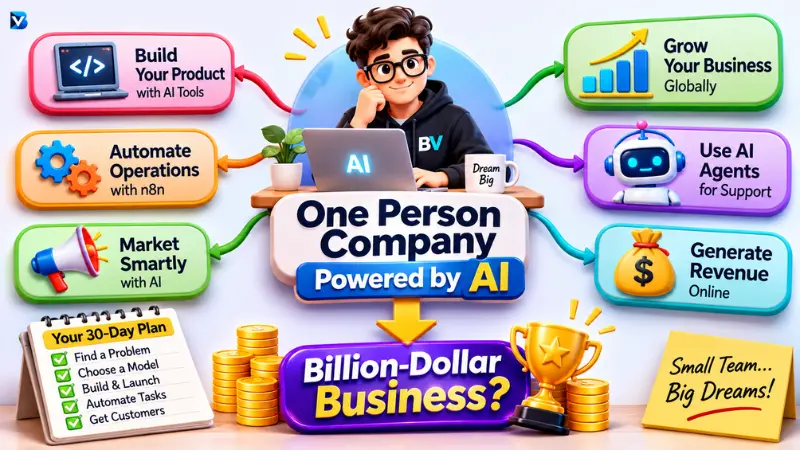
A one-person company is a business operated by a single founder who uses technology, AI tools, and automated workflows to complete tasks that traditionally required multiple employees. Instead of building a large team, the founder focuses on strategy, product development, customer relationships, and business growth while AI helps with execution.
The idea has attracted attention from technology leaders, entrepreneurs, and investors. OpenAI CEO Sam Altman has even discussed the possibility of a one-person company reaching a billion-dollar valuation.
But can one person really build a billion-dollar business using AI?
Let’s explore how this business model works, which companies demonstrate its potential, the tools entrepreneurs can use, and how beginners can start building an AI-powered business.
What Is a One-Person Company?
A one-person company is a business designed and operated by one individual using software, AI systems, automation, and digital distribution.
Unlike traditional businesses, which often increase their workforce as they grow, a one-person company tries to increase productivity through technology instead of continuously hiring employees.
For example, a solo founder might use:
- ChatGPT for research, writing, and business planning.
- AI coding assistants for software development.
- Automation platforms to connect business applications.
- AI chatbots for customer support.
- Email automation for customer communication.
- AI design tools for marketing materials.
- Analytics tools to understand business performance.
The founder remains responsible for important decisions, quality control, customer relationships, and business outcomes.
One-Person Company vs Traditional Company
| Feature | Traditional company | One-person company |
| Workforce | Multiple employees | One primary founder |
| Operations | Manual and team-based | AI-assisted and automated |
| Marketing | Marketing department | AI tools and automation |
| Development | Development team | Founder and AI coding tools |
| Customer support | Support representatives | AI-assisted support |
| Management | Multiple managers | Founder-led |
| Growth strategy | Often hiring-dependent | Technology and automation-led |
A one-person company is not necessarily a business without external help. It may use freelancers, contractors, agencies, or professional advisers when necessary.
The key idea is that the founder can operate the core business without depending on a large permanent workforce.
Important: In India, One Person Company (OPC) is also a specific legal company structure under the Companies Act, 2013. This article uses the broader business-model meaning, not only the Indian legal definition.
Why AI Is Changing the Future of Entrepreneurship
Artificial intelligence is reducing the time and effort needed to perform many business tasks.
Previously, an entrepreneur might need several specialists to research a market, create a website, develop software, produce marketing content, and manage customer communication.
Today, AI tools can assist with many of these responsibilities.
Here are five important changes.
1. AI Makes Software Development More Accessible
Software development was traditionally one of the biggest barriers for entrepreneurs.
Building an application required programming knowledge, development resources, testing, and ongoing maintenance.
AI coding assistants and natural-language development platforms are making parts of this process more accessible.
For example, a founder can use AI to:
- Generate basic application code.
- Explain programming errors.
- Create database queries.
- Build website components.
- Generate test cases.
- Prepare technical documentation.
- Understand unfamiliar code.
Tools such as ChatGPT, Claude, GitHub Copilot, and AI-powered application builders can support these tasks.
However, generated code still requires testing, security reviews, and human oversight.
2. AI Agents Can Automate Repetitive Work
AI agents can interact with tools, process information, and perform tasks based on instructions.
For example, a business may create a workflow that:
- Receives a new customer inquiry.
- Extracts the customer’s information.
- Check the CRM database.
- Categorizes the inquiry.
- Prepares a personalized response.
- Sends the information to the founder for approval.
This can reduce repetitive administrative work.
Platforms such as n8n allow users to connect applications, APIs, and AI capabilities into automated workflows.
The important difference between an ordinary automation and an AI agent is that an agent can use a language model to interpret information and decide which available tools to call.
3. Marketing Becomes More Accessible
Marketing can be expensive for a new company.
A solo founder needs to attract customers without spending too much time creating promotional material.
AI can help with:
- Blog post outlines.
- Social media content.
- Email newsletters.
- Advertising copy.
- Keyword research.
- Marketing campaign ideas.
- Customer segmentation.
AI-generated content should still be reviewed for accuracy, originality, and brand quality.
4. Customer Support Can Run Around the Clock
Customer support is another important area where AI can help.
An AI chatbot can answer common questions, explain products, provide basic troubleshooting instructions, and direct complex issues to a human.
For example, an online software business could create a knowledge base containing:
- Product information.
- Pricing details.
- Frequently asked questions.
- Setup instructions.
- Troubleshooting guides.
A support assistant can use this information to answer common questions.
However, refunds, sensitive financial matters, complaints, and unusual customer problems should have appropriate human review.
5. Global Distribution Is Easier
The internet allows small businesses to reach customers across different countries.
A founder can sell digital products, software subscriptions, online courses, templates, and other services through digital platforms.
AI can help with translation, marketing, documentation, and customer communication.
This makes it easier to test international markets without opening physical offices or building large local teams.
Can One Person Really Build a Billion-Dollar Company?
The idea of a one-person billion-dollar company has become a major topic in the technology industry.
Sam Altman discussed the possibility of a founder reaching a billion-dollar valuation without hiring employees. His prediction helped popularize the idea of a one-person unicorn.
However, a prediction is not proof that such a company already exists.
To understand the opportunity, it is important to examine actual business developments.
The Growth of Solo Founders
According to Carta’s Solo Founders Report 2025, the share of new startups on its platform with a solo founder increased from 23.7% in 2019 to 36.3% in the first half of 2025.
The report also found that solo-founded startups represented 30% of companies founded in 2024 but received 14.7% of the cash raised in priced equity rounds that year.
These figures show two important trends:
- Starting a company alone is becoming more common.
- Solo-founded companies still face challenges when raising venture capital.
The report covers companies on Carta’s platform, not every startup worldwide.
What Is a One-Person Unicorn?
A unicorn is generally a privately held startup valued at $1 billion or more.
A one-person unicorn would be a company reaching that valuation while being operated by one person.
AI could make this model more achievable by helping founders perform work that previously required larger teams.
However, reaching a billion-dollar valuation involves much more than automating business operations.
A company also needs:
- A large addressable market.
- Strong customer demand.
- A defensible product.
- Reliable technology.
- Sustainable economics.
- Competitive advantages.
- Strong customer retention.
AI can help with execution, but it cannot guarantee these outcomes.
Real Examples of AI-Powered Solo Businesses
Several businesses demonstrate how one founder or a small team can build valuable products with modern technology.
It is important to distinguish between a genuinely solo-operated business and a company that started with one founder but later hired employees.
1. Base44 – AI-Powered App Development
Base44 is an AI-powered platform that allows users to create applications using natural-language instructions.
Its founder, Maor Shlomo, started the company in 2025.
In June 2025, Wix announced its acquisition of Base44 for approximately $80 million in initial consideration, with additional earn-out payments.
The business attracted significant attention because it demonstrated how quickly an AI-powered software product could grow.
However, Base44 was not a one-person company throughout its entire independent operation. TechCrunch reported that it had eight employees at the time of the acquisition.
Lesson: A founder can use AI to accelerate product development, but scaling a successful product can still require a team.
2. Pieter Levels – Building Digital Products Independently
Pieter Levels is widely known in the independent software and startup community.
He has built internet businesses and digital products such as Nomad List and Photo AI.
His approach emphasizes:
- Building products quickly.
- Launching early versions.
- Getting customer feedback.
- Keeping operations relatively lean.
- Using technology to reduce unnecessary work.
His journey demonstrates the potential of building internet businesses without following the traditional startup structure.
However, individual revenue figures associated with independent businesses should be checked against their original reporting and should not automatically be treated as audited financial statements.
Lesson: A small product solving a specific problem can become a meaningful business without requiring a large organization.
3. HeadshotPro – AI Professional Photography
HeadshotPro offers AI-generated professional headshots.
It illustrates how an entrepreneur can build a specialized digital service around a clear customer need.
Instead of operating a traditional photography studio, an AI-powered product can automate parts of the image-generation process.
Its business model demonstrates how niche AI applications can serve customers who want a specific result.
Lesson: Solving one clear problem can be more valuable than trying to build a tool that does everything.
What These Examples Actually Prove
These examples demonstrate the potential of AI-powered software businesses and lean operations.
They do not prove that a single person has already built and operated a billion-dollar company without employees.
The distinction matters because revenue, profit, acquisition price, and company valuation are different financial measurements.
Best AI Tools for Building a One-Person Company
The right AI tools depend on the type of business you want to create.
You do not need dozens of subscriptions. Start with a small collection of tools that solve real operational problems.
| Tool | Main purpose | How founders can use it |
| ChatGPT | AI assistant | Research, writing and planning |
| Claude | AI assistant | Coding, analysis and documentation |
| GitHub Copilot | Coding assistant | Code generation and development |
| Cursor | AI code editor | Build and modify applications |
| n8n | Workflow automation | Connect applications and AI workflows |
| Zapier | Automation | Connect business applications |
| Canva | Design | Create marketing graphics |
| Notion | Productivity | Organize business information |
| HubSpot | CRM | Manage customer relationships |
| Stripe | Payments | Accept online payments where supported |
How to Choose the Right AI Tools
Do not select software just because it is popular.
Instead, identify the task that takes the most time in your business.
For example:
- If you struggle with coding, explore AI coding assistants.
- If you spend too much time on repetitive tasks, explore n8n.
- If customer inquiries consume your time, explore AI support tools.
- If you struggle with marketing, use AI for research and content assistance.
- If you lose track of leads, use a CRM.
Always review current pricing, usage limits, privacy terms, and integration capabilities before choosing a paid subscription.
How to Start a One-Person Company Using AI
Starting a one-person company does not require a complicated business plan or an expensive office.
The best approach is to identify a real problem, create a simple solution, and validate whether people will pay for it.
Here is a beginner-friendly process.
Step 1: Find a Problem Worth Solving
Start by researching problems that people or businesses regularly experience.
Examples include:
- Small businesses struggling with customer inquiries.
- Bloggers spend too much time creating content.
- Companies manually managing leads.
- Online stores handling repetitive customer questions.
- Freelancers managing invoices and client communication.
Look for problems that are frequent, expensive, frustrating, or time-consuming.
Do not start by asking, “What AI tool should I build?”
Instead, ask, “What problem can I solve better with AI?”
Step 2: Choose a Business Model
A one-person company can generate revenue in several ways.
Software as a Service (SaaS)
Build an online application and charge customers monthly or annually.
Examples:
- AI writing software.
- AI customer support platforms.
- Marketing automation software.
- Productivity applications.
Digital Products
Create downloadable products that customers can purchase online.
Examples:
- Templates.
- E-books.
- Educational resources.
- Business automation workflows.
- Digital guides.
AI Automation Services
Help businesses automate repetitive operations.
Examples:
- Email automation.
- Lead generation workflows.
- Customer support automation.
- CRM automation.
Content and Audience Businesses
Create valuable content and monetize it through advertising, sponsorships, subscriptions, and affiliate marketing.
Choose one model initially instead of trying to operate several businesses simultaneously.
Step 3: Build Your First Product
Once you understand the problem and business model, create a simple first version.
For a software business, this might be a small application with one useful feature.
For an automation service, it might be a workflow that saves a business time.
For a digital product business, it might be a practical template or guide.
Use AI tools to accelerate development, but make sure the product actually solves the problem.
Avoid spending months building features that customers have not requested.
Step 4: Automate Repetitive Operations
Once the product works, identify tasks that happen repeatedly.
For example:
- New customer registration.
- Welcome emails.
- Lead notifications.
- Appointment reminders.
- Customer support categorization.
- Payment notifications.
Use automation tools to connect these processes.
Start with low-risk workflows and test them carefully before allowing them to run without supervision.
Step 5: Find Your First Customers
A product without customers is not a successful business.
Start by finding people who already experience the problem you are solving.
You can use:
- Relevant online communities.
- LinkedIn.
- YouTube.
- Search engine content.
- Product launch platforms.
- Direct business outreach.
- Existing professional networks.
Ask potential customers about their problems before promoting your product.
Try to get your first paying customers before investing heavily in additional features.
Step 6: Measure Business Performance
Track important business metrics from the beginning.
| Metric | What it tells you |
| Monthly recurring revenue | Predictable subscription revenue |
| Customer acquisition cost | Cost of getting a customer |
| Customer lifetime value | Estimated value of a customer |
| Churn rate | Customers leaving the service |
| Gross margin | Revenue remaining after direct costs |
| Customer retention | How well you keep customers |
AI can help organize and analyze business data, but the founder must understand what the numbers mean.
Step 7: Improve and Scale
Once customers consistently use the product, improve the experience.
Focus on:
- Product reliability.
- Customer feedback.
- Better onboarding.
- Faster support.
- Lower operating costs.
- Stronger security.
- New customer acquisition channels.
Do not hire employees simply because a business starts growing.
However, do not avoid hiring when human expertise, accountability, or customer service genuinely requires it.
How to Automate a One-Person Business With n8n
One useful technology for solo founders is n8n.
It is a workflow automation platform that connects different applications and supports AI-powered workflows.
For example, imagine you run a small software business and want to automate incoming customer leads.
A simple workflow could look like this:
- A potential customer submits a website form.
- n8n receives the form information.
- An AI model categorizes the inquiry.
- The customer’s details are saved in a spreadsheet or CRM.
- An email notification is sent to the founder.
- A draft response is prepared for review.
- The founder approves the response before it is sent.
This workflow can reduce repetitive administrative work.
Example AI Automation Stack
| Component | Possible tool |
| Workflow engine | n8n |
| AI model | OpenAI API |
| Lead collection | Website form |
| Customer database | Google Sheets or CRM |
| Gmail | |
| Notifications | Slack or Telegram |
The exact tools depend on the business requirements and integration availability.
For sensitive actions, use human approval. The official n8n documentation supports human review for AI tool calls, including actions such as sending messages and modifying records.
This is particularly important when automating customer communication, payments, or business-critical operations.
Advantages and Disadvantages of One-Person Companies
A one-person company can offer significant advantages, but it also creates unique challenges.
Advantages
Lower operational complexity
A small operation generally has fewer management responsibilities and internal coordination requirements.
Faster decision-making
One founder can make many decisions without waiting for several departments.
More control
The founder retains greater control over product direction and business decisions.
Technology-driven productivity
AI can help with research, coding, content production, and repetitive administration.
Global business opportunities
Digital products and online services can reach customers in different countries.
Disadvantages
Founder dependency
When one person handles important decisions, illness, burnout, or personal emergencies can disrupt operations.
Limited human judgment
AI cannot reliably replace human expertise in every situation.
Technical and security risks
AI-generated code, automated actions, and connected applications can create vulnerabilities if not reviewed.
Customer support limitations
Complex complaints and sensitive issues may require human intervention.
Funding challenges
Solo founders may face difficulties attracting certain investors compared with teams that offer complementary expertise.
The Carta 2025 report highlights this funding difference in its analysis of solo-founded startups.
Challenges and Risks of Running an AI-Powered Business
AI can make business operations more efficient, but it does not remove every business risk.
1. Depending Too Much on AI
AI models can generate inaccurate information or incorrect code.
Always review important outputs before using them in production.
2. Ignoring Data Privacy
Business owners should understand what information is being sent to AI providers.
Avoid exposing customer passwords, sensitive financial details, or confidential business information unnecessarily.
3. Automating Everything Too Early
A poorly designed automation can send incorrect emails, update the wrong customer records, or create duplicate transactions.
Test workflows with sample data before enabling them for real customers.
4. Ignoring Customer Feedback
A technically impressive product can still fail if it does not solve a meaningful problem.
Talk to customers regularly and use their feedback to improve the product.
5. Choosing Too Many Tools
Using too many subscriptions can increase costs and create unnecessary complexity.
Start with a small tool stack and expand only when a genuine business need appears.
The Future of One-Person Companies
The future of entrepreneurship may involve smaller teams supported by increasingly capable AI systems.
AI agents, coding assistants, automated workflows, and digital distribution are making it possible for individuals to perform a wider range of business activities.
However, this does not mean traditional companies or employees will disappear.
Businesses still need people who can:
- Understand customers.
- Make strategic decisions.
- Develop original ideas.
- Build trust.
- Manage complex relationships.
- Take legal and financial responsibility.
- Handle situations where AI fails.
The most successful founders will likely be those who understand how to combine human judgment with AI capabilities.
The one-person billion-dollar company remains an ambitious possibility rather than an established business model.
But the growing number of solo-founded startups and AI-assisted businesses suggests that the traditional requirements for starting a company are changing.
Frequently Asked Questions
1. What is a one-person company?
A one-person company is a business operated by a single founder who uses technology, automation, and AI tools to manage operations and create scalable products or services.
2. Can one person build a billion-dollar company using AI?
It is theoretically possible, but there is no verified public example establishing that a single person has built and operated a billion-dollar company entirely alone using AI.
3. What are the best AI tools for a one-person company?
Popular options include ChatGPT, Claude, Cursor, GitHub Copilot, n8n, Zapier, Canva, and Notion. The best combination depends on your business model and requirements.
4. How do one-person companies make money?
They can generate revenue through SaaS subscriptions, digital products, online services, consulting, advertising, affiliate marketing, and other scalable business models.
5. Can beginners start an AI-powered business?
Yes. Beginners can start with a simple business problem, use existing AI tools, create a small product or service, and gradually improve it based on customer feedback.
6. Can AI replace employees in a one-person company?
AI can automate or assist with certain tasks, including research, writing, coding, and customer support. However, human judgment, accountability, and specialist expertise remain important.
7. What is the difference between a solopreneur and a one-person company?
A solopreneur is an individual who runs a business independently. A one-person company generally emphasizes building systems, products, and automated processes that can grow without a proportional increase in the founder’s working hours.
8. Is a one-person company the same as an AI startup?
No. A one-person company describes the way a business is operated. An AI startup describes a business that develops or uses AI as part of its product or operations. A company can be both.
Conclusion
The rise of one-person companies powered by AI represents an important change in entrepreneurship.
Today, an individual can use AI tools, software, and automation to perform work that previously required several specialists. This makes it easier to experiment with business ideas, launch digital products, and serve customers around the world.
However, building a successful company still requires more than technology. Founders need to understand customer problems, develop useful products, manage costs, and create sustainable revenue.
You do not need to start by building a billion-dollar company.
Start by solving one real problem for one group of customers. Use AI to make your work more efficient, automate repetitive processes, and improve your product over time.
The real opportunity is not simply running a business without employees. It is building a business where technology allows one person to create more value.
READ MORE:
How to Turn One Blog Post into 10 Social Media Posts Automatically with AI