Artificial Intelligence (AI) is changing quickly. Two of the most important ideas that are defining today’s AI environment are Generative AI and Agentic AI. Though they are often spoken about in the same breath, they are profoundly different in how they operate, what they generate, and how they interact with the world.
In this blog, we’ll break down both concepts in a simple, practical, and detailed way so you can clearly understand the difference—and why Agentic AI is being seen as the next major evolution after Generative AI.
What is Generative AI?
Generative AI refers to artificial intelligence systems that can create new content such as text, images, audio, video, and code based on patterns learned from large datasets.
Instead of just analyzing data, Generative AI produces something new.
How Generative AI Works
Generative AI models are trained on massive datasets. They learn patterns, structures, and relationships in the data, and then generate outputs that resemble the training material.
Common techniques include:
- Large Language Models (LLMs)
- Diffusion models (for images)
- GANs (Generative Adversarial Networks)
Examples of Generative AI
- Chatbots like ChatGPT (text generation)
- Image tools like Midjourney or DALL·E (image generation)
- AI music generators
- Code generation tools like GitHub Copilot
Key Characteristics
- Produces content on request
- Works in a prompt → response cycle
- Does not take independent actions
- No long-term planning by default
Simple Analogy
Generative AI is like a highly skilled artist or writer:
- You give instructions
- It creates content
- Then it stops
What is Agentic AI?
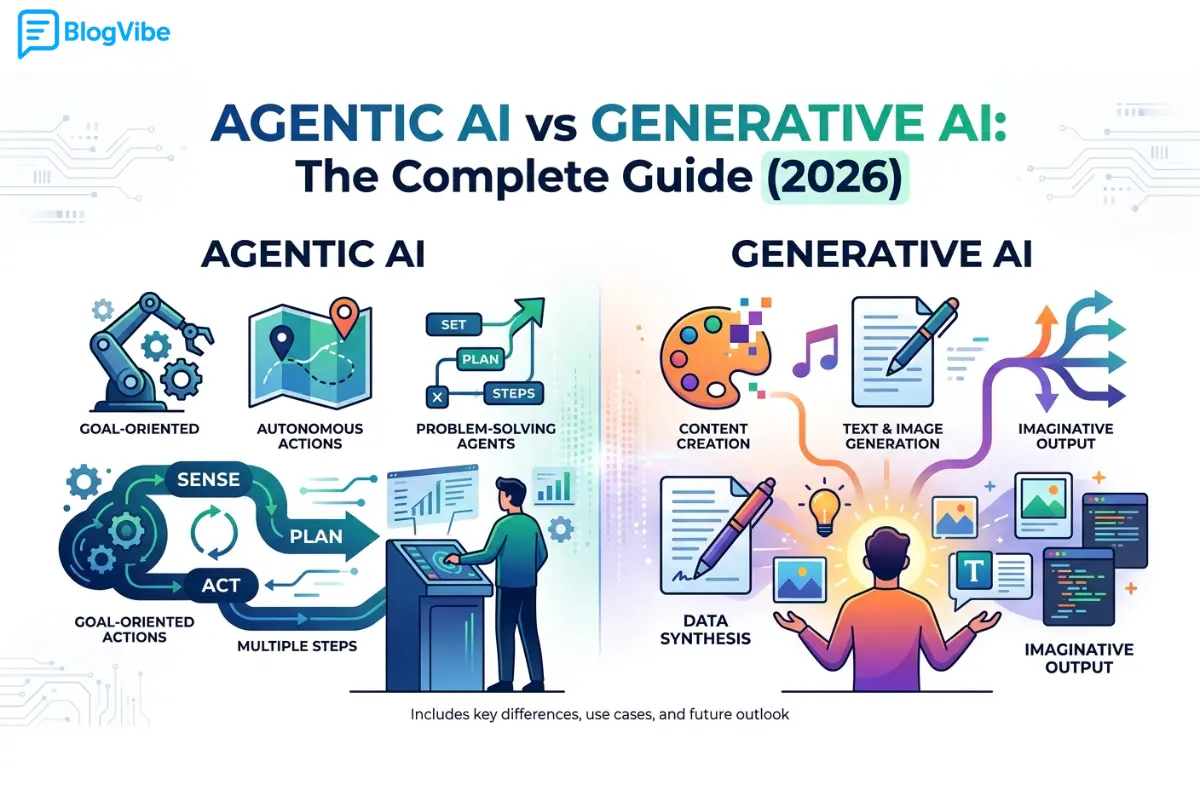
Agentic AI represents a newer type of AI system that can plan, decide, and take actions autonomously to achieve goals.
Instead of just responding to prompts, Agentic AI behaves more like an intelligent assistant that can:
- Break down goals into steps
- Use tools and APIs
- Make decisions dynamically
- Adapt based on feedback
How Agentic AI Works
Agentic AI systems typically include:
- A reasoning engine (decision-making)
- Memory (short-term and long-term)
- Tool usage (web, apps, APIs, databases)
- Planning modules
The process is more like:
Goal → Plan → Act → Observe → Improve → Repeat
Examples of Agentic AI
- AI research assistants that write and execute code
- Autonomous customer support bots that solve tickets end-to-end
- AI systems that manage workflows (emails, scheduling, reporting)
- Autonomous agents in robotics or simulations
Key Characteristics
- Goal-driven behavior
- Multi-step reasoning
- Can use external tools
- Can operate without constant human prompts
- Has a form of “memory” or state
Simple Analogy
Agentic AI is like a smart project manager:
- You give a goal
- It plans the work
- Assigns tasks (to tools or itself)
- Executes and checks results
- Keeps going until the job is done
Key Difference Between Generative AI and Agentic AI
The simplest way to understand the difference:
- Generative AI creates content
- Agentic AI completes tasks
Let’s break it down further.
1. Purpose
- Generative AI: Produce content (text, images, code)
- Agentic AI: Achieve goals and complete workflows
2. Interaction Style
- Generative AI: One prompt → one output
- Agentic AI: Continuous interaction until goal completion
3. Decision Making
- Generative AI: No independent decision-making
- Agentic AI: Makes decisions step-by-step
4. Memory
- Generative AI: Limited or session-based context
- Agentic AI: Maintains memory across steps/tasks
5. Tool Usage
- Generative AI: Rare or indirect tool usage
- Agentic AI: Actively uses tools (APIs, browsers, databases)
6. Autonomy
- Generative AI: Low autonomy
- Agentic AI: High autonomy
Real-World Example to Understand the Difference
Imagine you want to build a blog website.
With Generative AI:
You ask:
“Write HTML code for a blog website.”
It gives you:
- A block of HTML/CSS code
But then you must:
- Copy it
- Run it
- Fix errors
- Deploy it
With Agentic AI:
You say:
“Build me a blog website and deploy it.”
It can:
- Plan the website structure
- Generate code
- Fix bugs
- Test it
- Suggest hosting
- Even deploy it using tools
That’s the key difference—execution vs generation.
Architecture Difference
Generative AI Architecture
Generative AI typically follows:
- Input prompt
- Neural network processing
- Output generation
It is mostly stateless and reactive.
Agentic AI Architecture
Agentic AI includes multiple components:
- Planner → breaks goals into tasks
- Memory system → stores past actions
- Reasoning engine → decides next step
- Tool executor → performs actions
- Feedback loop → evaluates results
This creates a continuous loop of intelligence.
Use Cases of Generative AI
Generative AI is widely used in:
1. Content Creation
- Blogs
- Social media posts
- Ad copy
2. Design
- Logos
- Images
- UI mockups
3. Programming
- Code generation
- Debugging assistance
4. Entertainment
- Music generation
- Story writing
- Game asset creation
5. Education
- Summaries
- Explanations
- Tutoring tools
Use Cases of Agentic AI
Agentic AI goes beyond content generation into action-based systems:
1. Personal AI Assistants
- Managing emails
- Scheduling meetings
- Booking services
2. Business Automation
- Customer support resolution
- Invoice processing
- Workflow automation
3. Software Development
- Auto-building applications
- Debugging full systems
- Running tests automatically
4. Research Agents
- Collecting data from web
- Summarizing research papers
- Running experiments
5. Robotics and Autonomous Systems
- Self-driving systems
- Warehouse automation
- Drone coordination
Advantages of Generative AI
- Easy to use
- Fast content creation
- Highly creative outputs
- Supports many industries
- Low cost of entry
Limitations of Generative AI
- Doesn’t act independently
- Cannot complete full workflows
- No real-world execution ability
- Can produce inaccurate outputs (hallucinations)
- Requires human guidance
Advantages of Agentic AI
- Can complete full tasks end-to-end
- Reduces human workload significantly
- Automates complex workflows
- Can adapt dynamically
- Works continuously without constant input
Limitations of Agentic AI
- More complex to build
- Higher risk if misaligned
- Requires strong safety controls
- Can make compounding errors
- Needs access to external systems (security concerns)
Generative AI vs Agentic AI: Comparison Table
Feature | Generative AI | Agentic AI |
Output | Content | Actions + results |
Autonomy | Low | High |
Memory | Limited | Persistent |
Tools | Rare | Frequent |
Decision-making | None | Strong |
Goal handling | Single prompt | Multi-step goals |
Example | ChatGPT writing text | AI executing full projects |
How They Work Together
The future is not “Agentic AI vs Generative AI”—it’s both combined.
Agentic systems often use Generative AI models as their brain.
For example:
- Generative AI writes code
- Agentic AI decides what code is needed, runs it, tests it, and improves it
So:
Generative AI is the engine
Agentic AI is the driver
Future of AI: Where Are We Heading?
The next stage of AI evolution is moving toward:
1. Fully Autonomous AI Workers
AI that can:
- Work like employees
- Handle end-to-end tasks
- Collaborate with other AI agents
2. AI Operating Systems
Instead of apps, users will give goals:
“Manage my business finances”
And AI agents will handle everything.
3. Multi-Agent Systems
Multiple AI agents working together:
- Research agent
- Coding agent
- Design agent
- Manager agent
4. Human-AI Collaboration
Humans will focus on:
- Strategy
- Creativity
- Decision oversight
AI will handle execution.
Conclusion
The difference between Generative AI and Agentic AI is not just technical—it represents a shift in how we use technology.
- Generative AI is about creating content.
- Agentic AI is about completing tasks and achieving goals.
Generative AI gave us creative machines.
Agentic AI is giving us autonomous digital workers.
Together, they are shaping the next generation of intelligent systems that will transform industries, jobs, and daily life
Frequently Asked Questions (Agentic AI vs Generative AI)
1. What is the main difference between Generative AI and Agentic AI?
Generative AI creates content like text, images, or code based on prompts, while Agentic AI can plan and execute tasks autonomously to achieve a goal.
2. Is ChatGPT Generative AI or Agentic AI?
ChatGPT is mainly Generative AI, but when combined with tools, memory, and automation features, it can behave like Agentic AI in some systems.
3. Can Agentic AI replace humans?
Not completely. Agentic AI can automate tasks and workflows, but humans are still needed for:
- Decision-making
- Ethics
- Creativity direction
- Oversight and control
4. Which is more powerful: Generative AI or Agentic AI?
Agentic AI is generally more powerful because it can take actions and complete tasks, not just generate outputs. However, it often depends on Generative AI models to function.
5. What are examples of Generative AI tools?
Some popular examples include:
- ChatGPT (text generation)
- DALL·E (image generation)
- Midjourney (AI art)
- GitHub Copilot (code generation)
6. What are examples of Agentic AI systems?
Examples include:
- AI workflow automation tools
- Autonomous research agents
- AI customer support systems that resolve tickets
- Multi-agent systems that manage business operations
7. Will Agentic AI replace Generative AI?
No. Agentic AI actually uses Generative AI as its core engine. Both will work together rather than replace each other.
8. Why is Agentic AI important for the future?
Agentic AI is important because it enables:
- Full task automation
- Digital AI workers
- Smarter business systems
- Reduced human workload
9. Can beginners learn Agentic AI easily?
Yes, but it requires understanding:
- Machine learning basics
- APIs and tools
- Prompt engineering
- Workflow automation
10. What is the future of AI?
The future is a combination of:
- Generative AI (content creation)
- Agentic AI (task execution)
- Multi-agent systems (AI teams working together)