Most of us think we’re too smart to fall for a phone scam. This confidence is precisely what today’s fraudsters are counting on. Now, with three or four seconds of recorded audio, an attacker can clone a voice good enough to fool a family member, a bank or a healthcare call center. Enter the agentic AI Pindrop
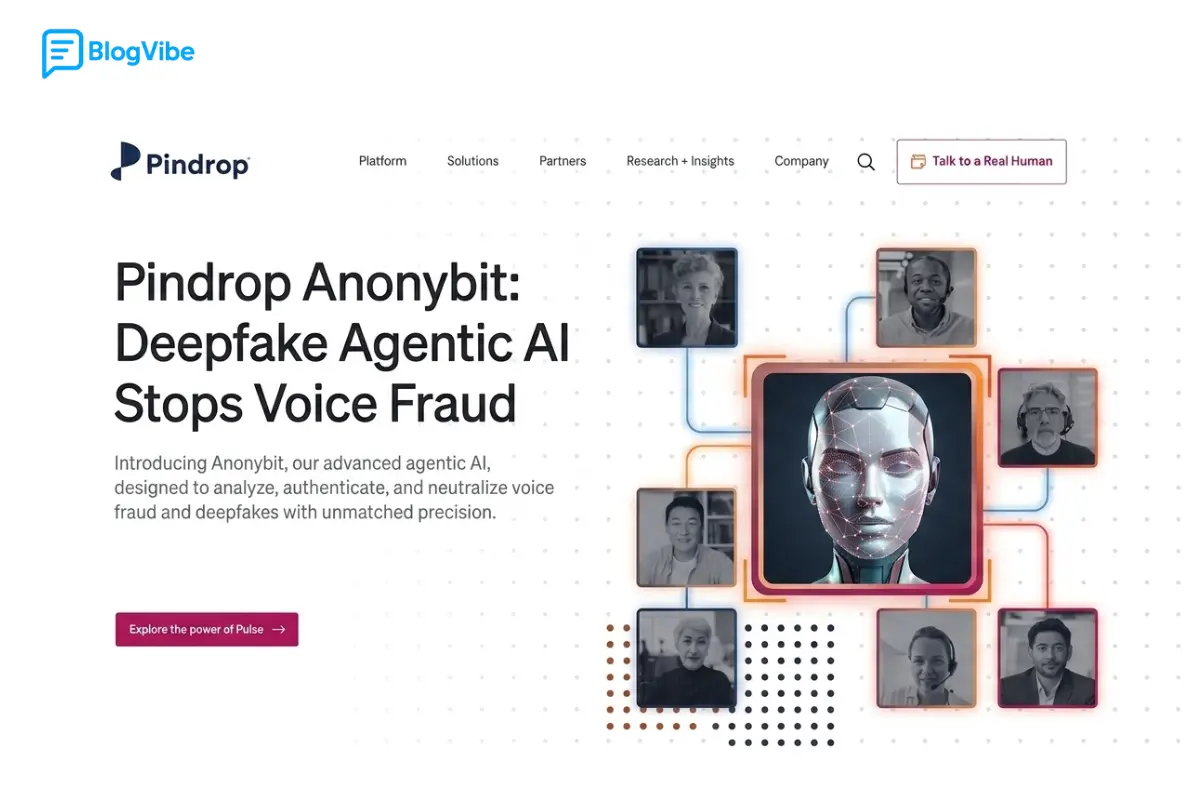
It ends with bigger anti-fraud solutions you can deploy with it.
Fraud is rampant – and AI has made it worse
The problem isn’t theoretical anymore. Consumers said they lost $12.5 billion to fraud in 2024 in roughly 2.6 million reports to the U.S. Federal Trade Commission, a steep climb fueled in part by AI-fueled impersonation
The voice channel is a prime target:
- The Pindrop 2025 Voice Intelligence & Security Report revealed a 1,300%+ increase in deepfake fraud, and the emergence of “deepfake job candidates” who use cloned voices and
- video to dupe recruiters. Contact-center fraud increased by roughly 60% in two years, and the latest estimates suggest that one in 730 calls to a contact center is fraudulent — an estimated
- $5 billion annual risk to U.S. contact centers. One early case that people cite a lot: a CEO of a U.K. energy company was tricked into wiring about $243,000 in 2019 after a deepfaked voice
impersonated his boss at the parent company. Traditional defenses are static and rules-based: passwords, security questions, IP blocklists.
Founded in 2011 in Atlanta by Dr. Vijay Balasubramaniyan, Dr. Paul Judge and Dr. Mustaque Ahamad, Pindrop is a voice-security and identity company backed by investors including Andreessen Horowitz, Citi Ventures, CapitalG, GV, IVP and Vitruvian Partners. The company specializes in voice authentication, fraud detection and deepfake detection in contact centers, and more recently has expanded to live meetings.
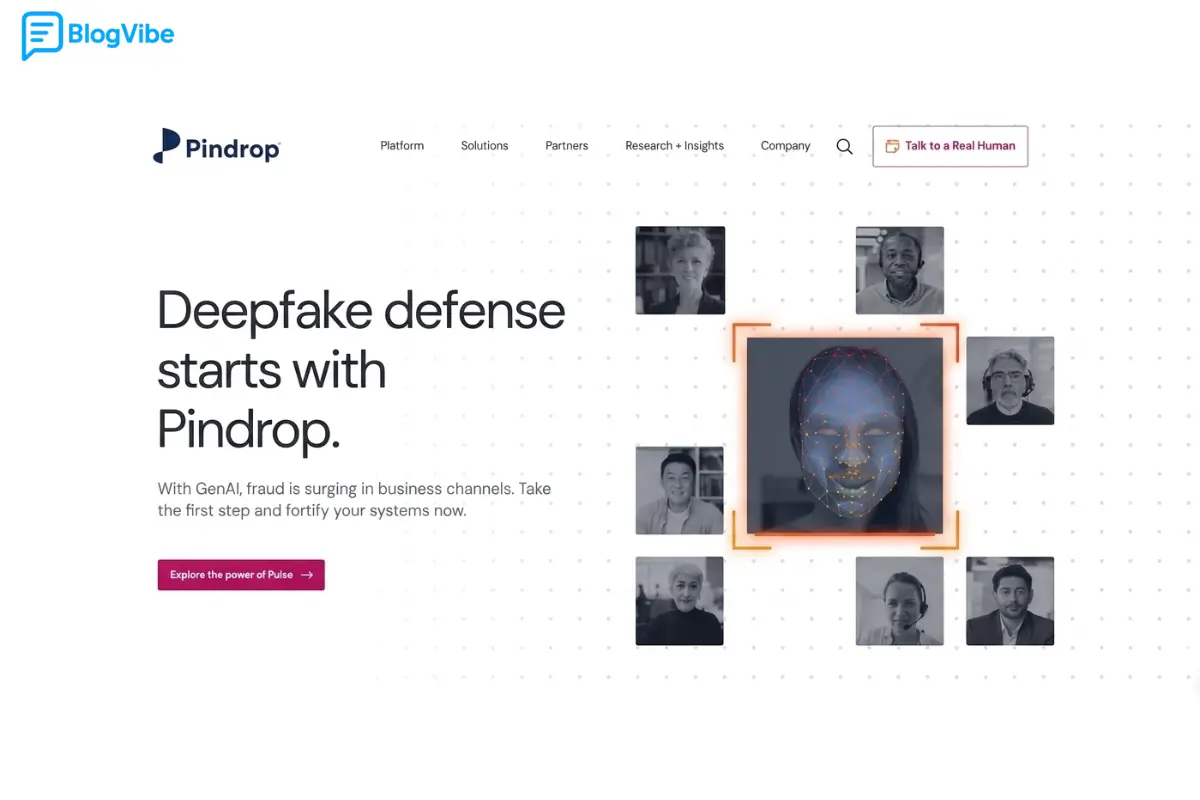
Pindrop doesn’t just match a caller’s voice to a stored voiceprint, it analyzes more than 1,300 voice, device and behavioral signals to generate a single risk score and a “liveness” score, a real-time signal as to whether a voice is a live human or a synthetic source. In its public disclosures the company said it analyzed 5.3 billion calls, stopped about $2 billion in fraud losses and detected 104 million spoof calls.
The product family core:
| Product | What it does |
| Pindrop® Protect | Multi-layered fraud detection that delivers one risk score across both the IVR and live-agent stages of a call. |
| Pindrop® Passport | Passive multifactor authentication that verifies genuine callers without security questions or one-time passcodes. |
| Pindrop® Pulse | AI-powered deepfake/liveness detection that flags synthetic audio in about two seconds. |
| Pindrop® Pulse for Meetings | Real-time deepfake detection, attendee authentication, and geolocation checks for video meetings. |
| Pulse Inspect / fraud-investigation agent | Tools that re-score prior calls with new intelligence and an AI agent that helps investigators resolve phone-fraud cases faster.
|
As for trust signals, it is worth noting Pindrop’s credibility markers: Pindrop was the sole winner in the large-organization category at the 2024 U.S. Federal Trade Commission Voice Cloning Challenge, and in 2026 TIME included it in its list of the most influential software companies, along with Microsoft, Adobe, and Figma. Customer HealthEquity in healthcare saw >90% reduction in voice fraud after deployment.
Pindrop Deepfake Detection Approach Explained
Pindrop’s deepfake detection approach is built on the idea that synthetic speech leaves artifacts humans can’t hear but machines can measure. The Pulse engine listens for tells such as:The basis for Pindrop’s deepfake detection is that synthetic speech creates artifacts that are inaudible to humans but measurable by machines. The Pulse engine listens for tells like:
- Strange compression artifacts from text-to-speech pipelines
- Unnatural frequency distributions a real vocal tract would not make
- Missing the background and room cues that real live audio almost always has
From these signals, it generates a liveness score in about two seconds. Pindrop states that Pulse can reach up to 99.2% accuracy on synthetic and bot-generated speech, and up to 99.4% accuracy with less than 1% false positives when combined with its multifactor authentication platform. It also claims over 90% accuracy in detecting new deepfakes, even as attackers continuously evolve their tools.
This capability is supported by more than 75 deepfake-related patents. The core idea is to detect fraud early—ideally in the IVR stage—so high-risk calls can be routed to specialized fraud teams instead of standard agents
Read more:Best AI Agents for Small Businesses and Entrepreneurs
Building Trust with Agentic AI From Pindrop and Anonybit
A liveness score alone is just a signal. The “building trust with agentic AI from Pindrop” idea is about what happens after the signal fires — and this is where the agentic AI Pindrop Anonybit framework comes together as three complementary layers:“Liveness score alone is just a signal. The “building trust with agentic AI from Pindrop” idea is about what happens after the signal fires – and this is where the agentic AI Pindrop Anonybit framework comes together as three complementary layers:
| Layer | What it handles | Purpose |
|---|---|---|
| Pindrop | Verifies whether a caller’s voice is the real account owner or a deepfake | Audio verification |
| Anonybit | Confirms biometric identity without exposing the raw biometric data | Identity management |
| Agentic AI | Reads context across signals and decides the next action | Autonomous decision-making |
Anonybit uses decentralized biometric authentication by splitting fingerprint, face, or voice data across multiple clouds instead of storing it in a central vault. This reduces breach risk and supports GDPR and HIPAA compliance by avoiding full data reconstruction.
Agentic AI then acts as the decision layer, analyzing real-time behavior to detect risk and decide actions like allowing access, triggering step-up authentication, or escalating to human review. This enables continuous, adaptive trust instead of one-time verification.
Deploying Pindrop Company MSSP Solutions
Pindrop Features, Benefits and Drawbacks
Strengths
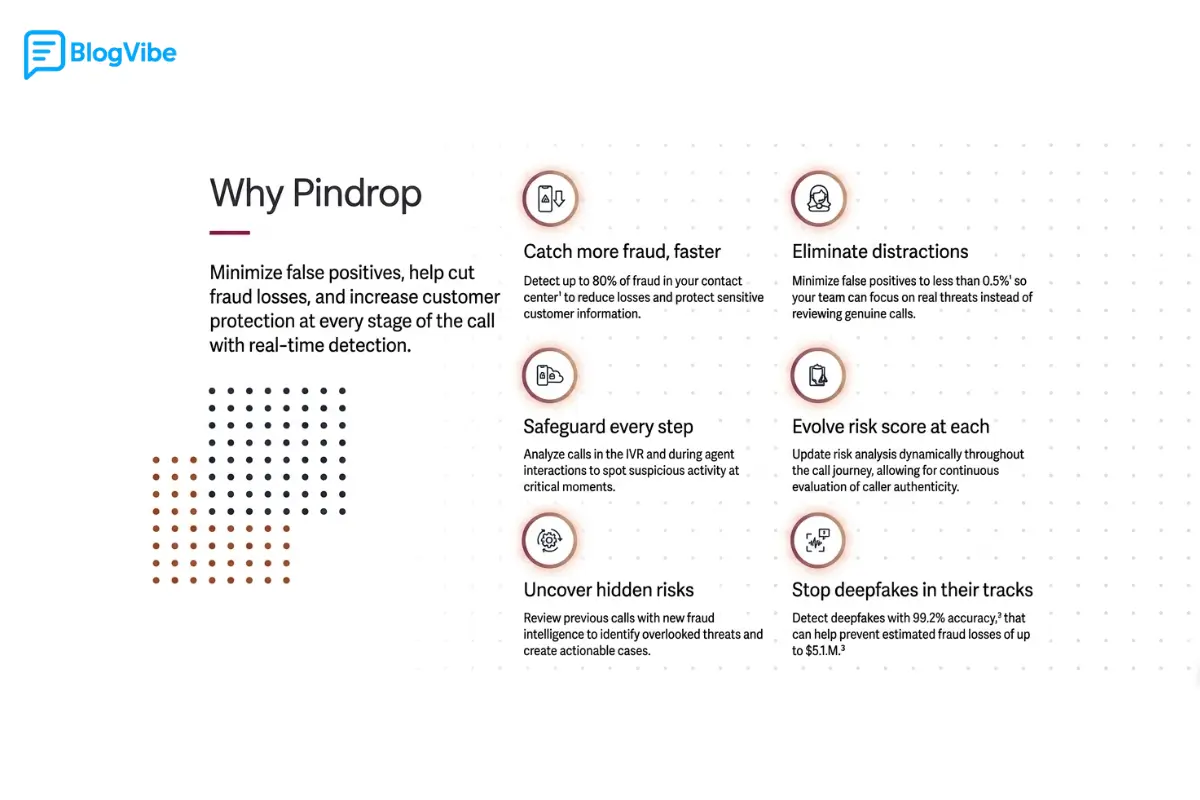
- Fast and accurate detection: Delivers deepfake verdicts in around ~2 seconds with strong reported accuracy and low false positives.
- Passive authentication: Verifies legitimate customers without requiring security questions or one-time passcodes, reducing friction.
- Wide signal coverage: Uses 1,300+ voice, device, and behavioral signals instead of relying on a single voiceprint.
- Strong generalization: Built to detect previously unseen deepfakes, not just known or trained samples.
- Real-world validation: Backed by large-scale enterprise deployments, billions of analyzed calls, and recognition such as the FTC challenge win.
Shortcomings
- Not perfect detection: Even advanced systems can occasionally miss threats or allow some fraud attempts through, especially if improperly configured.
- Enterprise-focused: No public pricing or self-serve option, making it unsuitable for small businesses or individual use.
- Integration complexity: Performance depends heavily on proper tuning within a contact center’s existing infrastructure and call flow.
- Voice-channel limitation: Primarily focused on phone-based fraud, so additional layers are needed for email, app, and identity verification flows—often paired with biometric solutions like Anonybit for full coverage.
How much does Pindrop cost?
Pindrop does not publish pricing publicly. Gartner Peer Insights and software directories indicate a custom, quote-based model with annual or multi-year subscriptions depending on call volume and deployment requirements. Additional costs may apply for integration support and premium features.
Overall, it follows an enterprise procurement process with tailored pricing rather than fixed rates. For budgeting purposes, it is typically considered a six-figure-plus annual contract, common for contact-center security platforms, and requires a vendor quote based on specific usage needs.
Hear from Real Users
Independent Review Sentiment
Independent feedback volume is relatively modest, but overall sentiment is generally positive. On Gartner Peer Insights, Pindrop’s fraud detection products are typically rated in the 4.4–4.6 star range by verified users.Not a huge amount of feedback but the feedback is generally positive. Verified users rate Pindrop’s fraud detection products between 4.4 and 4.6 stars on Gartner Peer Insights.
What users commonly report
- Some daily users note that the system effectively intercepts fraud attempts and appreciate recent improvements to the interface, while also mentioning that a small number of fraudulent calls can still occasionally pass through.
- Others describe the platform as easy to use and highlight its fast performance and quick loading times.
- Buyers often point to strong visibility into caller behavior and smooth integration with existing security infrastructure, though they also mention that initial tuning is required for best results.
Overall takeaway
The common theme across reviews is that the system is effective and low-friction for real-world use, but works best when carefully configured rather than being treated as a wholly plug-and-play solution.
Context note for search spikes
Beyond Pindrop: Other Fraud Solutions
Don’t put all your eggs in one basket. Use a layered security approach. Organizations can also improve protections through the following approaches, either in addition to or instead of solutions like Pindrop:
- Decentralized biometrics (e.g., Anonybit):
Enables identity verification without storing centralized biometric databases, reducing the impact of potential breaches and supporting compliance with regulations such as GDPR and HIPAA. - Adaptive or risk-based MFA:
Replaces static one-time passwords with context-aware authentication that adjusts security steps based on behavioral signals and risk anomalies. - Multimodal deepfake detection:
Expands protection beyond voice to include face-swap and video injection detection. Industry data, including reports referenced by iProov, shows a rise in face-swap attacks, particularly in video onboarding and meetings. - MSSP-managed monitoring:
Outsources 24/7 security monitoring, tuning, and incident response to managed security service providers, especially useful for organizations without dedicated internal security teams. - Verification rituals for families and staff:
Simple offline methods such as shared code words or verification phrases can effectively mitigate “loved-one in distress” voice-cloning scams. - Employee and customer training:
Organizations like the FTC and CISA provide free resources on recognizing AI-driven impersonation threats. Human awareness remains a critical layer of defense.
Key authoritative resources
- FTC fraud data and consumer alerts
- CISA guidance on deepfakes and synthetic media
- NIST AI Risk Management Framework for governing AI-related security risks
Conclusion
FAQs
What is the difference between Pindrop and traditional voice authentication?
Is the agentic AI Pindrop Anonybit framework GDPR and HIPAA compliant?
Does it work for video calls?
How much does Pindrop cost?
Pricing is not publicly disclosed and typically depends on enterprise scale, call volume, and deployment requirements. It is generally sold as an enterprise solution rather than a self-serve product.
Is Pindrop only for big companies?
In practice, yes. Pindrop is primarily designed for enterprise contact centers. Smaller organizations usually access similar capabilities through managed security service providers (MSSPs) that implement and operate the technology on their behalf.