

Artificial intelligence (AI) and automation are changing the way businesses operate, people work, and everyday tasks are completed. From automated emails to intelligent chatbots, these technologies are helping individuals and organizations save time and improve productivity.
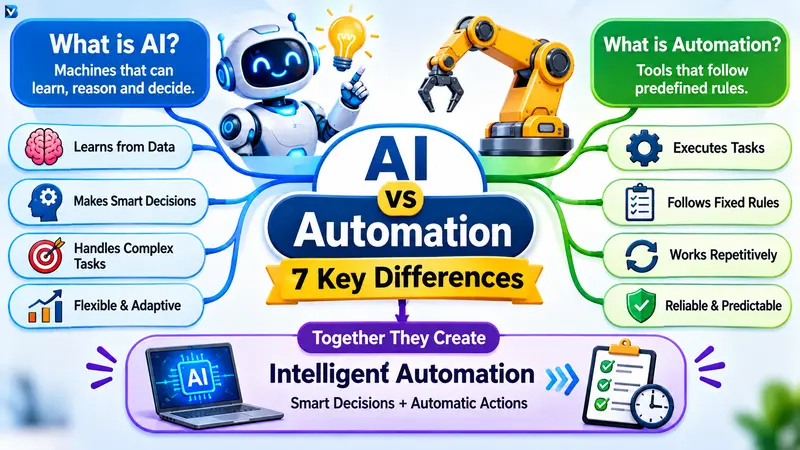
However, many people confuse AI with automation. Although they are closely related, they are not the same thing.
The main difference between AI and automation is that automation follows predefined instructions to complete tasks automatically, while artificial intelligence can analyze information, recognize patterns, understand language, and generate predictions or responses.
For example, an automated email system sends a welcome message whenever someone subscribes to a newsletter. An AI-powered system can analyze a customer’s interests and generate personalized recommendations.
Businesses can also combine both technologies to create smarter workflows that reduce repetitive work and improve efficiency.
In this article, we will explore AI vs automation, seven important differences, real-world examples, advantages, disadvantages, and how to choose the right technology for your needs.
What Is Artificial Intelligence (AI)?
Artificial intelligence (AI) is a field of computer science that focuses on creating systems capable of performing tasks that typically require human-like intelligence.
These tasks include understanding language, recognizing images, identifying patterns, solving problems, making predictions, and generating content.
AI systems process information using algorithms, models, and data to produce useful outputs.
For example, AI can:
- Understand questions and generate conversational responses.
- Recognize objects in photographs.
- Analyze customer reviews and feedback.
- Recommend products based on user preferences.
- Generate articles, images, and videos.
- Identify unusual patterns in financial transactions.
Machine learning is one of the major areas of AI. It allows computer systems to learn patterns from training data and use those patterns to make predictions or classifications.
Real-world examples of AI
1. AI Chatbots
AI chatbots understand customer questions and generate relevant responses. They can help users find information, troubleshoot problems, and interact with businesses.
2. Recommendation Systems
Online shopping platforms and streaming services can analyze user behavior and recommend products, movies, music, or other content.
3. Image Recognition
AI-powered image recognition systems identify objects, detect patterns, and classify images.
4. Predictive Analytics
Businesses use machine learning models to analyze historical information and estimate possible future outcomes.
5. AI Writing Tools
AI writing applications help users generate drafts, summarize information, improve grammar, and organize ideas.
For more information, explore IBM’s guide to artificial intelligence.
What Is Automation?
Automation is the use of technology, software, machines, or predefined workflows to perform tasks with minimal human involvement.
Instead of manually repeating the same process, users configure a system to execute instructions automatically.
Traditional automation is particularly useful for repetitive tasks that follow predictable steps.
For example:
- Sending an email after someone subscribes to a website.
- Generating an invoice after a successful payment.
- Updating a spreadsheet when new information arrives.
- Publishing social media posts at scheduled times.
- Sending reminders when a deadline approaches.
Automation saves time by reducing manual work and helping businesses complete routine processes consistently.
Real-world examples of automation
1. Email Automation
An email marketing system automatically sends welcome messages, order confirmations, and scheduled newsletters.
2. Industrial Automation
Machines and robotic equipment perform repetitive manufacturing operations in factories.
3. Business Workflow Automation
Workflow applications transfer information between different software systems and complete predefined operations.
4. Banking Automation
Banks use automated processes to send transaction notifications, generate statements, and process routine requests.
5. Website Automation
Website owners can automatically publish scheduled content, back up files, and manage notifications.
Automation does not necessarily require artificial intelligence. Many automated systems work entirely through predefined instructions and conditions.
AI vs Automation: 7 Key Differences
AI and automation can both improve productivity, but they perform different roles.
Here are seven important differences that explain how these technologies work.
1. Purpose and Function
The primary purpose of traditional automation is to complete predefined tasks without requiring repeated manual input.
Artificial intelligence focuses on capabilities such as interpreting information, recognizing patterns, generating content, and producing predictions.
Consider an online shopping website.
Traditional automation can send a confirmation email whenever a customer completes an order.
AI can analyze customer preferences and recommend products that may interest them.
The business can then combine both technologies to recommend relevant products and automatically send order-related notifications.
Key difference: Automation focuses on executing tasks, while AI provides capabilities for interpreting information and generating intelligent outputs.
2. How Decisions Are Made
Traditional automation follows predefined instructions and conditional rules.
AI systems use models, learned patterns, or other computational methods to generate outputs based on available information.
For example, imagine a customer sends a message asking for a refund.
A traditional automated system might search for the word “refund” and forward the message to a particular department.
An AI-powered system can interpret the message, identify the customer’s actual request, and classify it according to its context.
An automated workflow can then forward the request to the appropriate team.
Key difference: Traditional automation follows configured decision rules, while AI can interpret more complex information using its underlying models.
3. Learning and Adaptability
Traditional rule-based automation does not independently learn from new examples. When requirements change, the workflow may need updated instructions.
Machine-learning systems can identify patterns from training data and use those patterns when processing new information.
For example, a basic automated email system might send the same reminder to every customer after seven days.
An AI recommendation system can analyze customer preferences and suggest different products to different users.
However, AI does not always learn continuously during operation. Many machine-learning models require separate training, testing, and deployment updates.
Key difference: Traditional automation generally depends on configured rules, while machine-learning systems can use patterns learned from data to handle different inputs.
4. Handling Data and Inputs
Traditional automation works particularly well when information is structured and follows a predictable format.
AI can process different types of information, including text, images, audio, and other complex inputs, depending on the model being used.
For example, an automated invoice system may work with predefined invoice fields and formats.
An AI-powered document processing system can help extract information from invoices with different layouts.
This makes AI useful for tasks involving unstructured information that would be difficult to handle using only fixed rules.
Key difference: Rule-based automation is effective with predictable inputs, while AI can help interpret more varied and unstructured information.
5. Flexibility and Predictability
Traditional automation is generally predictable because its instructions determine how the process operates.
AI can be more flexible when handling different inputs, but its outputs may vary depending on the information and context.
For example, a scheduled reporting workflow follows the same configured steps whenever it runs.
An AI system summarizing customer reports may generate different summaries depending on the content of each report.
This does not mean every AI system is unpredictable. Some AI applications are designed to produce highly consistent results, and automation systems can also contain complex conditional rules.
Key difference: Traditional automation emphasizes repeatable execution, while AI offers more flexibility for tasks that require interpretation.
6. Cost and Complexity
Traditional automation can be more economical when a process is repetitive and its instructions are easy to define.
AI may require additional resources, such as model access, data preparation, testing, monitoring, and output validation.
For example, a simple welcome email does not need an expensive AI model.
However, analyzing thousands of customer messages and identifying their meaning may benefit from AI because creating individual rules for every possible message would be difficult.
Businesses should consider whether AI provides enough additional value to justify its cost and complexity.
Key difference: Traditional automation is suitable when predefined rules are sufficient, while AI is useful when interpreting information provides additional value.
7. Human Involvement
Both AI and automation require human involvement in setup, oversight, and maintenance.
However, the responsibilities can differ.
Traditional automation requires people to configure workflows, define instructions, and update rules when processes change.
AI requires people to select suitable models, evaluate outputs, monitor performance, check data quality, and establish safeguards.
For important financial, legal, or customer-related decisions, human approval may still be necessary.
Key difference: Automation depends on configured instructions, while AI systems require appropriate model evaluation, oversight, and safeguards.
AI vs Traditional Automation: Comparison Table
The following table summarizes the major differences.
| Feature | Traditional Automation | Artificial Intelligence |
| Main purpose | Execute predefined tasks | Interpret information and generate outputs |
| Logic | Configured rules | Models, patterns, or reasoning |
| Learning | Does not usually learn independently | Machine-learning systems learn during training |
| Data | Structured information works well | Can process varied information |
| Flexibility | Depends on configured rules | Can handle different input patterns |
| Output | Usually predictable | May vary depending on context |
| Maintenance | Update instructions and workflows | Evaluate and maintain models |
| Examples | Email notifications and scheduled reports | Chatbots and image recognition |
It is important to remember that AI and automation are not mutually exclusive. Many modern business systems combine both technologies.
AI and Automation Examples in Real Life
Practical examples make the difference between AI and automation easier to understand.
Here are five common applications.
1. Email Management
Traditional automation: Automatically moves emails containing predefined keywords into specific folders.
Artificial intelligence: Identifies the meaning of emails and categorizes them according to topics, urgency, or intent.
Combined approach: AI categorizes incoming messages, while automation forwards them to the appropriate department.
2. Customer Support
Traditional automation: Sends predefined responses to frequently asked questions using fixed rules.
Artificial intelligence: Understands customer questions and generates relevant responses.
Combined approach: AI prepares a response, while automation manages ticket creation, routing, and follow-up notifications. Sensitive cases can be escalated to human employees.
3. Online Shopping
Traditional automation: Sends order confirmations, shipping notifications, and payment reminders.
Artificial intelligence: Analyzes available customer data to recommend relevant products.
Combined approach: AI generates personalized product recommendations, while automation manages inventory updates and order notifications.
4. Business Finance
Traditional automation: Generates invoices, schedules payment reminders, and updates financial records.
Artificial intelligence: Helps extract information from documents and identify unusual transaction patterns.
Combined approach: AI extracts and classifies invoice details, while automated workflows validate required fields and send invoices for approval.
5. Content Creation
Traditional automation: Publishes scheduled articles and shares website links on social media.
Artificial intelligence: Helps generate content drafts, summarize research, and suggest article topics.
Combined approach: AI assists with content preparation, while automation schedules approved posts and organizes publishing tasks.
These examples show that AI and automation can complement each other rather than compete.
What Is the Difference Between Machine Learning and Automation?
Machine learning and automation are often confused, but they describe different concepts.
Machine learning is a subset of artificial intelligence that uses data to train models for tasks such as prediction, classification, and pattern recognition.
Automation is the use of technology to perform tasks or processes with reduced manual involvement.
Consider a simple business example:
- Machine learning predicts which customers may be interested in a product.
- Automation sends a promotional email to customers selected by an approved workflow.
- Intelligent automation can combine these capabilities to personalize and execute the process.
For example, a business can use a machine-learning model to identify potential customers and an automated workflow to organize follow-up messages.
Learn more through Google Cloud’s machine learning guide.
How AI and Automation Work Together
AI and automation do not always need to operate separately.
Combining these technologies can help businesses create workflows that interpret information and then perform repeatable actions.
Consider a website that receives customer inquiries.
A combined workflow could operate as follows:
Step 1: Customer submits a form
A visitor completes a contact form on the website.
Step 2: Automation starts the process
The submitted information is transferred to the appropriate processing system.
Step 3: AI analyzes the message
AI identifies whether the inquiry relates to sales, technical support, billing, or another topic.
Step 4: Automation routes the request
The workflow sends the inquiry to the appropriate department.
Step 5: Human approval when necessary
Important or uncertain requests are sent to an employee for review.
This workflow combines AI-assisted interpretation with automated execution.
Businesses can use similar approaches for customer service, invoice processing, marketing, document management, and internal operations.
For additional information, explore AWS’s guide to AI automation.
Advantages and Disadvantages of AI and Automation
Both technologies offer important benefits, but they also have limitations.
Advantages of Artificial Intelligence
- Handles complex information: AI can interpret text, images, audio, and other data.
- Supports decision-making: Machine-learning models can help identify patterns and make predictions.
- Personalization: AI can generate recommendations based on available user information.
- Content generation: Generative AI can assist with writing, summarizing, and creating digital content.
- Flexible applications: AI can support different tasks across multiple industries.
Disadvantages of Artificial Intelligence
- Incorrect outputs: AI can generate inaccurate information or misleading results.
- Implementation costs: Some applications require additional computing resources and paid services.
- Data privacy: Poor data handling can create privacy and security risks.
- Monitoring requirements: AI systems need evaluation and ongoing oversight.
- Unpredictable results: Different inputs can produce different outputs.
Advantages of Traditional Automation
- Saves time: Repetitive tasks can be completed automatically.
- Consistency: Configured processes can perform the same steps repeatedly.
- Reduces manual work: Employees can spend more time on tasks requiring human attention.
- Predictability: Rule-based workflows generally produce consistent results.
- Scalability: Automated processes can help manage growing workloads.
Disadvantages of Traditional Automation
- Limited flexibility: Fixed rules may struggle with unexpected situations.
- Maintenance: Changing processes may require updates to workflows.
- Complex rules: Large numbers of conditions can become difficult to manage.
- Input requirements: Some workflows depend on structured and predictable data.
- Exceptions: Unusual situations may require manual intervention.
Which Technology Offers Better Value?
Neither technology is automatically better.
Traditional automation can be the more practical choice for predictable tasks. AI can be useful when a process requires interpretation, pattern recognition, or predictions.
Combining both can provide value when a business needs intelligent processing and reliable task execution.
When Should You Use AI vs Automation?
Choosing between AI and automation depends on the process you want to improve.
Choose Traditional Automation When:
- Tasks follow clear and repeatable instructions.
- The same process happens regularly.
- Information follows predictable formats.
- Consistency is more important than interpretation.
- A simple workflow can solve the problem.
Examples include scheduled emails, automatic backups, invoice reminders, and data transfers.
Choose AI When:
- Information requires interpretation.
- Tasks involve understanding language or images.
- You need to identify patterns in large datasets.
- Different inputs require different responses.
- Predictions or recommendations provide useful value.
Examples include customer sentiment analysis, image recognition, content assistance, and predictive analytics.
Choose Both When:
- You need to interpret complex information and perform automatic actions.
- Multiple applications need to exchange information.
- Your workflow includes repetitive steps and variable inputs.
- AI outputs need to trigger predefined business processes.
- Human approval is required for important decisions.
The best solution is the simplest technology that reliably solves the actual problem.
Common Mistakes to Avoid
Businesses and beginners sometimes misunderstand the relationship between AI and automation.
Here are five common mistakes.
1. Assuming All Automation Uses AI
Traditional automation can work without artificial intelligence.
For example, scheduled backups and automatic email notifications can operate using simple predefined rules.
2. Assuming AI Always Works Independently
An AI model may generate a recommendation or response without having the technical ability or permission to perform an action.
Additional tools and workflows may be required to execute tasks.
3. Using AI for Simple Repetitive Tasks
Not every process needs artificial intelligence.
If a basic rule can complete the task accurately, adding an AI model may increase unnecessary costs and complexity.
4. Trusting Every AI-Generated Result
AI outputs can contain errors.
Businesses should review important results and establish validation processes before using AI outputs in important decisions.
5. Ignoring Human Oversight
People should define system boundaries, monitor performance, and review high-impact decisions.
A well-designed AI automation workflow should include appropriate human approval and exception handling.
Frequently Asked Questions About AI vs Automation
1. What is the main difference between AI and automation?
Automation performs tasks using predefined instructions, while artificial intelligence uses technologies such as machine learning and other computational methods to analyze information, recognize patterns, and generate predictions or responses.
2. Is AI the same as automation?
No. AI and automation are different concepts. AI provides capabilities such as language understanding and pattern recognition, while automation executes processes automatically. Both technologies can work together.
3. Can automation work without AI?
Yes. Traditional automation works without artificial intelligence. Examples include scheduled emails, automatic backups, order confirmations, and invoice reminders.
4. Can AI work without automation?
Yes. An AI chatbot can answer questions, generate text, or analyze information without automatically executing a business workflow.
5. What are examples of AI vs traditional automation?
Traditional automation includes scheduled reports, automatic notifications, and payment reminders. AI examples include image recognition, predictive analytics, and intelligent text classification.
6. What is the difference between machine learning and automation?
Machine learning trains models to identify patterns and make predictions using data. Automation uses technology to execute configured tasks and processes. Machine learning can also be incorporated into automated systems.
7. Which is better for small businesses, AI or automation?
Both can be useful. Small businesses can start with traditional automation for repetitive tasks such as email notifications and appointment reminders. AI can help with customer inquiries, content assistance, and data analysis when those capabilities provide enough value.
8. Is robotic process automation (RPA) considered AI?
Traditional RPA is not automatically AI. RPA generally uses software bots to perform repetitive tasks by following configured instructions. However, RPA can be combined with AI technologies to interpret documents, classify information, and handle more complex workflows.
9. Will AI replace traditional automation?
Not necessarily. Many business processes will continue to benefit from predictable rule-based automation. AI can extend these systems by helping them process more varied information and support complex decisions.
10. How do AI and automation work together?
AI analyzes or interprets information, while automation can execute actions based on the AI output. For example, AI can categorize customer emails and an automated workflow can send them to the appropriate department.
Conclusion
Understanding AI vs automation is important for anyone interested in modern technology, digital productivity, and business improvement.
Traditional automation is designed to execute predefined processes consistently, while artificial intelligence introduces capabilities such as pattern recognition, language understanding, content generation, and prediction.
Both technologies have different strengths and limitations. Automation is often the practical choice for predictable repetitive tasks, while AI can help when information requires interpretation or analysis.
The most effective approach is not always choosing one over the other. Many useful business systems combine AI for interpretation with automation for execution.
Whether you are a blogger, developer, entrepreneur, or business owner, understanding these technologies can help you discover new ways to improve workflows and reduce repetitive work.
READ MORE:
What Is Basic Automation? 7 Easy Examples for Beginners